


Introduction:
How do you choose the right Shopify migration agency? Pick a team that has already moved stores from your current platform, treats SEO and data checks as dedicated workstreams, commits to a clear scope and timeline, and keeps supporting you after launch. Check their portfolio and references, ask the questions below, and compare itemized quotes from at least two or three Shopify migration experts.
Moving your online store to Shopify is a strategic decision, but it takes careful planning, precise execution and expert guidance. In this guide to choosing the right Shopify migration agency we cover the benefits of hiring one, the factors and questions that separate a good agency from a risky one, cost and budgeting, app and data migration best practices, how agencies protect your search rankings, and how they carry your theme and design across. We last reviewed it in October 2026 against current Shopify and Google guidance.
If you want to see how we deliver this work, browse our case studies, or talk to our team about your own migration.
Benefits of Using a Shopify Migration Agency
A Shopify migration agency is a team of Shopify specialists that plans and carries out the move of your store from its current platform to Shopify. That covers products, customers, orders, content, apps, design and URL redirects, and it usually includes support after launch.
Migrating an online store to a new platform like Shopify is a significant undertaking, and it’s only natural to consider whether you should handle it in-house or enlist the expertise of a Shopify migration agency. In this section, we’ll explore the multitude of benefits that come with choosing the latter option.
First and foremost, Shopify migration agencies bring a wealth of experience and specialized knowledge to the table. These professionals have likely overseen numerous migrations, and they’re well-versed in the intricacies of the Shopify platform. This means they can navigate the migration process with a level of efficiency and precision that’s hard to achieve when going it alone.
Time is often of the essence when it comes to business operations, and a migration is no exception. By opting for a Shopify migration agency, you can significantly expedite the process. Instead of spending valuable time and resources on learning the ins and outs of Shopify and managing the migration yourself, you can rely on experts who have streamlined processes and can execute the transition swiftly.
One of the most critical advantages of working with a migration agency is the risk mitigation it provides. Migration projects can be fraught with challenges, including data loss, website downtime, and potential SEO ranking drops. However, agencies are well-prepared to anticipate and mitigate these risks. They employ tried-and-tested strategies to ensure data integrity, minimize downtime, and protect your website’s search engine rankings during and after migration.
Moreover, when you engage a Shopify migration agency, you gain access to a dedicated team of professionals who can provide ongoing support. They can troubleshoot any issues that may arise post-migration, ensuring a smoother transition for your customers and minimizing disruptions to your business operations.
Who Does Migrations to Shopify? Your Options
Migrations to Shopify are done by you (copy and paste or CSV import), by a migration app from the Shopify App Store, by a Shopify Partner such as a migration agency, or through a custom build on the Shopify API. Shopify’s own migration guide lists these options from least to most technically complex.
Copy and paste or CSV import: suits a small catalog and a handful of pages. Some data cannot be moved this way.
Migration apps: automate the transfer of products, customers and orders from a supported platform, but they do not plan your redirects, integrations or design.
A Shopify Partner or migration agency: manages the whole project, including data mapping, SEO, theme, integrations, testing and launch.
A custom solution: built with the Shopify API when your data or systems are too complex for an app, usually by an agency.
To shortlist agencies, the Shopify Partner Directory lets you filter by service (including store migration), read reviews and see each partner’s tier: Select, Plus, Premier or Platinum. Shopify’s guide to choosing a migration partner notes that tiers and credentials are a useful signal but should not be the only basis for your decision.
Your source platform matters too. We have dedicated pages for moving from WooCommerce, Magento, BigCommerce, Salesforce Commerce Cloud and Adobe Commerce.
Factors to Consider When Selecting a Shopify Migration Agency
There is no single best Shopify migration agency for everyone. The best one for you is the agency with proven experience on your source platform and store size, a clear plan for SEO and data, and references you can check. Selecting the right agency is a pivotal decision in ensuring the seamless transition of your online store. In this section, we will delve into the crucial factors that demand your attention when evaluating potential agencies. These considerations will help you make an informed choice that aligns with your specific business needs and goals.
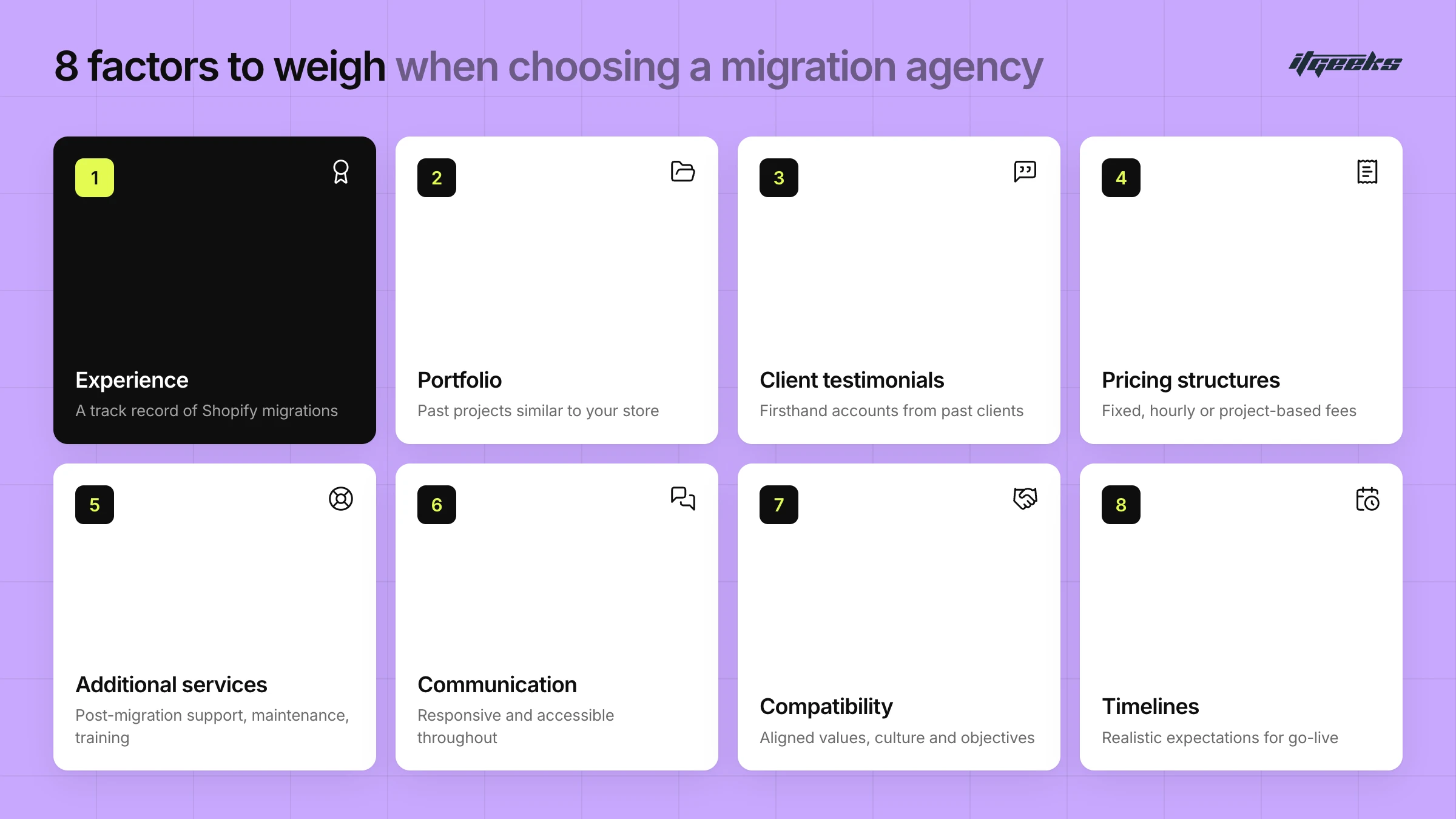
Experience: Perhaps the foremost factor to assess is the agency’s experience in handling Shopify migrations, ideally from your current platform. A seasoned agency will have a track record of successfully assisting businesses in similar transitions. They’ll be well-versed in the intricacies of migrating various types of online stores and will have refined their methodologies to ensure a smooth process.
Portfolio: A glance at the agency’s portfolio can provide invaluable insights into their capabilities. Review their previous migration projects to gauge the diversity and scale of their work. Look for examples of businesses that share similarities with your own, as this can indicate their expertise in your niche. Our work and case studies pages show the format to expect.
Client Testimonials: Client feedback and testimonials can offer firsthand accounts of an agency’s performance. Pay close attention to what past clients have to say about their experiences. Positive testimonials can instill confidence, while any recurring negative themes should raise caution flags.
Pricing Structures: Understanding the agency’s pricing structure is essential for budgeting purposes. Different agencies may have varying pricing models, such as fixed rates, hourly rates, or project-based fees. Ensure you have a clear understanding of the costs involved and any potential additional charges.
Additional Services: Consider whether the agency offers supplementary services beyond the basic migration process. Some agencies provide post-migration support, ongoing maintenance, or even training for your team to navigate the new Shopify environment effectively. These added services can significantly impact your overall migration experience and long-term success.
Communication and Support: Effective communication is key to a successful migration project. Evaluate how responsive and accessible the agency’s team is during the initial consultation and throughout the migration process. A responsive and supportive agency can address issues promptly and keep you informed every step of the way.
Compatibility: Ensure that the agency you choose is a good fit for your business in terms of values, culture, and objectives. A strong alignment in these areas can foster a more productive and collaborative working relationship.
Timelines: Discuss the expected timeline for your migration project with the agency. It’s essential to have realistic expectations regarding when the migration will be completed and your Shopify store will go live.
Red Flags When Hiring a Shopify Migration Agency
Shopify’s guide to choosing a migration partner stresses a clear strategy, data reconciliation, SEO as its own workstream, and a post-launch stabilization plan. The opposite of each is a warning sign:
No written plan for URL inventory, 301 redirect mapping and redirect testing.
One fixed approach for every store, with no discussion of a phased versus all-at-once launch.
Vague answers on how data accuracy is checked (products, customers, orders, inventory) after the transfer.
No clear owner for the day-to-day project, or no escalation path when something breaks.
Support that ends the day you go live.
Common Challenges in Shopify Migrations and How Agencies Address Them
Migrating an online store to a new platform, such as Shopify, is indeed a transformative endeavor, but it can also be rife with complexities and challenges that require careful navigation. In this section, we will explore some of the most common hurdles that businesses encounter during Shopify migrations and shed light on how expert migration agencies adeptly address these issues, ultimately ensuring a smoother and more successful transition.
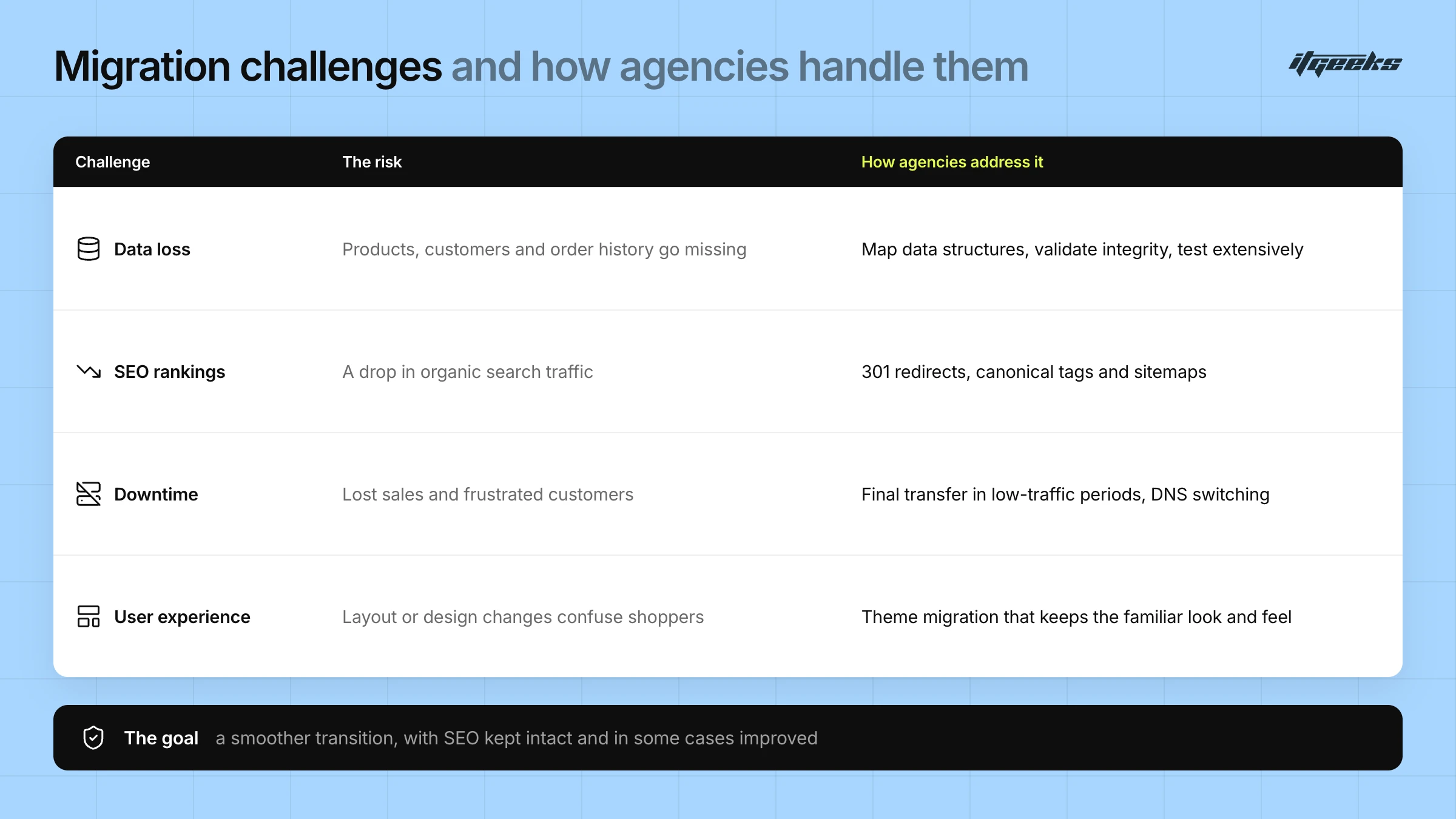
One of the foremost concerns in any migration is the risk of data loss. Businesses accumulate vast amounts of crucial data over time, including product listings, customer information, order history, and more. Transferring this data accurately to the new Shopify store is paramount. Migration agencies are well-versed in data migration best practices, using robust tools and methodologies to minimize the risk of data loss. They meticulously map data structures, validate data integrity, and perform extensive testing to ensure that all critical information seamlessly transfers to the new platform.
Another pressing issue businesses face is the potential impact on search engine rankings, known as SEO (Search Engine Optimization). A migration can disrupt carefully crafted SEO strategies and lead to a drop in organic search traffic if not handled properly. Experienced migration agencies recognize the importance of maintaining SEO integrity. They employ strategies like 301 redirects, canonical tags, and sitemaps to preserve your website’s SEO authority during the transition. By carefully managing the migration process, they aim to minimize any adverse SEO effects.
Downtime is another concern that businesses worry about during migrations. Even a short period of website downtime can result in lost sales and frustrated customers. Shopify migration agencies are acutely aware of this issue and work diligently to minimize downtime. They plan migration schedules strategically, often performing the final data transfer during periods of lower site traffic. Additionally, agencies typically keep the old store live while the new Shopify store is built and tested, then switch the domain (DNS, the Domain Name System) once everything has been checked, which keeps interruptions to a minimum.
Moreover, user experience is a key consideration during migrations. Any disruptions or changes to the layout, design, or functionality of your online store can confuse and frustrate customers. Migration agencies take great care to ensure that the new Shopify store mirrors the look and feel of the previous platform, unless you are deliberately redesigning. They work on theme migration, maintaining a consistent design, and functionality to ensure that customers can navigate and make purchases without any hitches.
Shopify Migration Agency vs. DIY Migration: Pros and Cons
Hiring a Shopify Migration Agency:
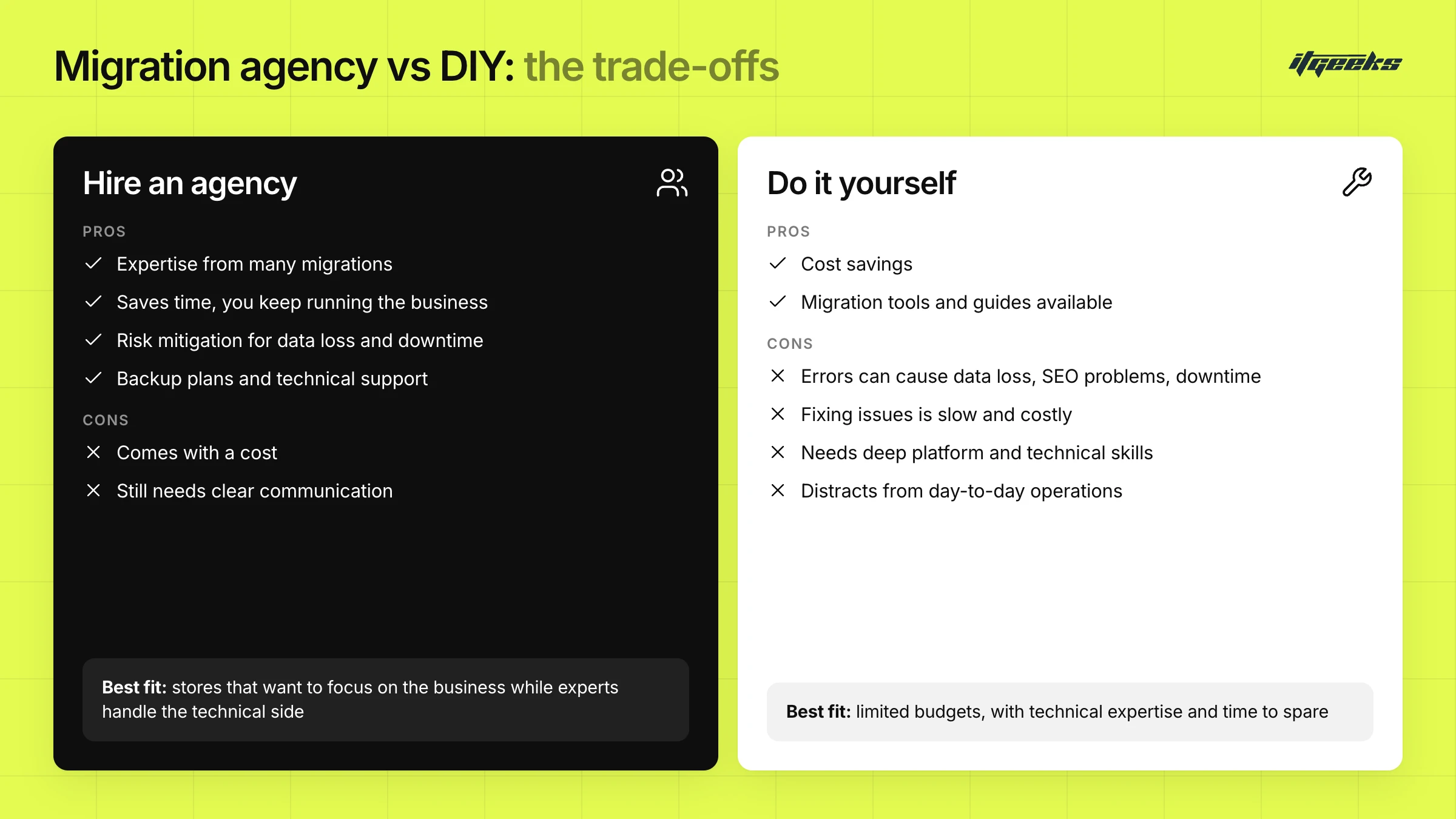
One of the most significant advantages of enlisting a Shopify migration agency is the expertise they bring to the table. These agencies specialize in e-commerce migrations, and their experience can be invaluable. They’ve navigated countless migrations and are well-versed in the intricacies of the Shopify platform. This expertise translates into a smoother, more efficient transition.
Moreover, hiring an agency can save you a considerable amount of time and effort. Migration is a complex process that involves transferring not just product data but also customer information, order history, and more. With an agency’s help, you can focus on running your business while they handle the technical aspects.
Agencies also provide a level of security and risk mitigation. They are equipped to address common migration challenges, such as data loss or downtime. Plus, they often have backup plans and technical support in place to deal with unexpected issues, ensuring that your business doesn’t suffer during the migration.
However, it’s essential to acknowledge that hiring an agency comes with a cost. This can be a significant factor for small businesses with limited budgets. The pricing structure of migration agencies can vary, and it’s crucial to budget accordingly. Additionally, the success of the migration may still depend on clear communication and collaboration between your business and the agency.
DIY Migration:
The primary advantage of a DIY migration is cost savings. If you have the technical expertise and time to spare, you can attempt to migrate your Shopify store on your own. There are migration tools and resources available that can guide you through the process, including Shopify’s migrating guide, which notes that import order matters: products first, then customers, then historical orders. For businesses with limited budgets, this option can be appealing.
However, the DIY approach also comes with its fair share of disadvantages. The most significant challenge is the potential for errors. Migrating an e-commerce store is a complex task, and mistakes can lead to data loss, SEO problems, and even site downtime. It’s essential to be aware that fixing these issues can be time-consuming and costly.
Moreover, a DIY migration can be a significant drain on your time and resources. It requires a deep understanding of both your current platform and Shopify, as well as the technical skills to handle the transfer seamlessly. For many business owners, this can be overwhelming and distracting from day-to-day operations.
Questions to Ask Potential Shopify Migration Agencies
When it comes to selecting the ideal Shopify migration agency for your e-commerce transition, asking the right questions is paramount. This phase of evaluation ensures that you not only find an agency that fits your specific needs but also establishes a transparent and productive working relationship. Here, we’ve compiled a comprehensive list of questions to pose to potential migration agencies, providing insights into their experience, methodology, timelines, and client references.
Experience and Expertise: Begin by understanding the agency’s level of experience in e-commerce migrations, particularly with Shopify. Ask about the number of successful migrations they’ve completed, the types of businesses they’ve worked with, and any relevant certifications or partnerships with Shopify. This will help you gauge their proficiency in handling your migration.
Methodology and Approach: Delve into their migration methodology. Ask how they plan, execute, and monitor migrations. Inquire about the tools and technologies they use to ensure a smooth transition. Understanding their approach will give you confidence in their ability to manage your migration effectively.
Project Timeline and Milestones: Time is often of the essence when it comes to e-commerce migrations. Discuss the expected project timeline, including key milestones and deadlines. It’s crucial to align their timeframe with your business goals to minimize disruption.
Data Security and Privacy: Data security is paramount in e-commerce. Seek information on how the agency handles data security and privacy during the migration process. Ask about encryption, compliance with regulations, and measures taken to prevent data breaches.
Downtime and Site Performance: Understand how they plan to minimize downtime during the migration. Inquire about strategies to maintain site performance and user experience throughout the transition. Reliable agencies will have contingency plans in place.
Scalability and Future Growth: Explore how the agency accommodates scalability and future growth. Can they adapt to your evolving needs as your business expands? This question is crucial for long-term success.
Client References and Case Studies: Request client references and success stories related to similar migration projects. Contacting past clients can provide valuable insights into the agency’s track record and customer satisfaction.
Support and Post-Migration Services: Ask about the support and post-migration services they offer. Inquire about their availability for addressing any issues or adjustments after the migration is complete. Reliable agencies provide ongoing support to ensure your store’s continued success.
Costs and Budgeting: Transparency regarding costs is essential. Discuss pricing structures and any potential additional charges. Ensure that the agency provides a clear breakdown of costs, helping you budget effectively.
Communication and Reporting: Effective communication is key to a successful partnership. Inquire about their communication channels and reporting frequency. Knowing how updates and progress will be shared can help you stay informed throughout the migration process.
Best Shopify Migration Agency for Complex Stores
The best Shopify migration agency for a complex store is one that has delivered comparable projects (ERP or order-management integrations, multiple markets, B2B pricing, large catalogs or custom checkout) and can explain its migration strategy, data validation and SEO plan in detail. Ask for named references on similar builds, not just logos.
Shopify’s partner guide suggests that a mid-market migration with limited integrations takes roughly 3 to 5 months, while an enterprise migration with ERP, OMS, international markets or custom checkout takes roughly 6 to 12 months. For complex stores, press agencies on:
System of record: which system stays the source of truth for inventory, orders, customers and pricing after launch.
Data reconciliation: how they prove that counts and values match between the old and new store, beyond mapping fields.
Launch strategy: why they would recommend a phased or an all-at-once launch for your business, and the top risks of that choice.
Performance and peak readiness: what load and checkout testing happens before a sale season.
Stabilization: what monitoring and support you get in the 30 to 90 days after go-live.
Our guide to Shopify Plus migration mistakes to avoid covers the pitfalls to check for on larger projects.
Cost Considerations: Budgeting for Your Shopify Migration
When contemplating a migration to the Shopify platform, one of the pivotal aspects to factor into your decision-making process is the cost associated with the transition. Migrations, whether from another e-commerce platform or when upgrading within Shopify, can indeed vary substantially in terms of expenses. The ultimate cost is typically influenced by the complexity of the project and the array of services required to ensure a seamless migration.
First and foremost, it’s essential to recognize that the cost of a Shopify migration is an investment in the future success and growth of your online business. While it’s natural to have concerns about costs, approaching the migration as a strategic investment can provide a clearer perspective.
The complexity of your migration project plays a significant role in determining the overall cost. For instance, if you have a small online store with a limited product catalog and straightforward data structures, your migration may be relatively straightforward and cost-effective. However, if you run a large-scale e-commerce operation with extensive product listings, complex database structures, and a need for customization, your migration will likely be more intricate and, consequently, more costly.
In addition to complexity, the services required will also impact the budget. Typical services provided by migration agencies include data migration, app integration, theme migration, SEO preservation, and post-migration testing and support. The more comprehensive the services, the higher the associated cost.
Budgeting effectively for your Shopify migration involves several key steps. First, it’s advisable to conduct a thorough audit of your existing e-commerce platform to understand the scope of the migration. Identify the data, apps, and design elements that need to be transferred. Then, request quotes from multiple Shopify migration agencies to compare costs and services.
Consider allocating a contingency budget for unforeseen issues that may arise during the migration process. Migrations don’t always go entirely according to plan, and having a buffer in your budget can help you navigate unexpected challenges without compromising your project’s success.
Ask every agency for an itemized quote that separates data migration, theme and design work, app and integration work, SEO and redirects, testing, launch and post-launch support. Prices vary widely between freelancers, boutique agencies and enterprise partners, so we do not quote a range here. Comparing like-for-like scope is more reliable than comparing totals.
How Long Does a Shopify Migration Take?
It depends on complexity. Shopify’s partner guidance puts a mid-market migration with limited integrations at roughly 3 to 5 months and an enterprise migration with ERP, OMS, international markets or custom checkout at roughly 6 to 12 months. A small store with a simple catalog can be quicker. Agree on milestones in writing and avoid launching right before your busiest season.
Furthermore, think about the long-term benefits of a smooth migration. While there is an upfront cost involved, a well-executed migration can lead to increased efficiency, improved customer experience, and potentially higher revenues in the long run. It’s crucial to view the migration cost in the context of these future gains.
Shopify App and Data Migration: Agency Best Practices
Migrating data and applications when transitioning to the Shopify platform is a crucial step in ensuring a smooth and successful transition. However, it’s a task that comes with its fair share of complexities and challenges. In this section, we’ll delve into the best practices employed by migration agencies to navigate this delicate process, guaranteeing a seamless transfer of your valuable data and applications to Shopify.
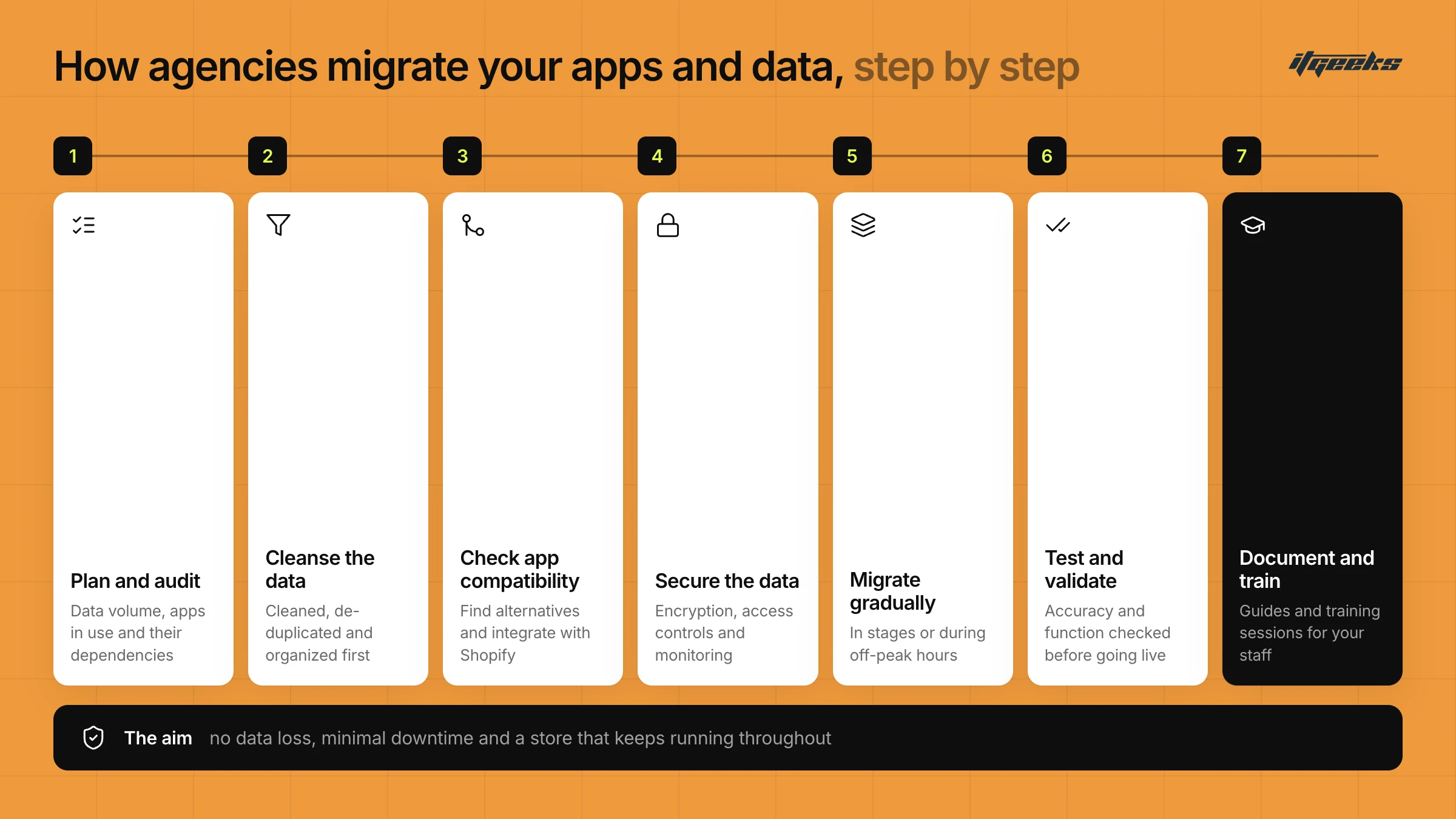
First and foremost, one of the primary best practices is thorough planning. Migration agencies typically start by conducting a comprehensive audit of your existing data and applications. They assess the volume of data, the types of applications in use, and the dependencies between them. This meticulous planning phase helps in creating a detailed roadmap for the migration, minimizing the chances of data loss or disruption.
Next, migration agencies emphasize the importance of data cleansing and organization. Before the actual migration takes place, data is often cleaned, de-duplicated, and organized to ensure that only relevant and accurate information is transferred. This step not only reduces clutter but also improves the overall data quality on the Shopify platform.
When it comes to application migration, agencies often prioritize compatibility and integration. They assess whether the existing applications are compatible with Shopify or if alternatives need to be found. If integration is required, agencies work on ensuring that the new applications seamlessly integrate with the Shopify ecosystem to maintain functionality and enhance the user experience.
Data security is also a paramount concern during migration. Migration agencies implement stringent security measures to protect sensitive customer information and proprietary data during the transition. This includes encryption, access controls, and monitoring to prevent any data breaches or unauthorized access.
To minimize downtime and disruptions to your business operations, migration agencies often opt for gradual data and application migration. This means that data is transferred in stages or during off-peak hours to avoid interrupting the normal flow of your e-commerce operations. It’s a strategy designed to keep your online store running smoothly throughout the migration process.
Testing and validation play a pivotal role in ensuring the success of data and application migration. Before finalizing the transition, agencies conduct extensive testing to verify the accuracy and functionality of the transferred data and applications on the Shopify platform. Any issues or discrepancies are addressed promptly to ensure a flawless user experience post-migration.
Lastly, documentation and training are crucial aspects of agency best practices. Migration agencies often provide comprehensive documentation for your team on how to use the new data and applications effectively within Shopify. They may also offer training sessions to ensure a smooth transition for your staff.
The Role of SEO in Shopify Migrations: Agency Strategies
SEO, or Search Engine Optimization, plays a pivotal role in the success of any e-commerce business. It directly impacts your online visibility, organic traffic, and ultimately, your revenue. When it comes to migrating your online store to the Shopify platform, ensuring that your hard-earned SEO rankings are preserved and optimized is of utmost importance. In this section, we’ll delve into the crucial role that SEO plays in Shopify migrations and the strategies employed by migration agencies to safeguard and enhance it.
One of the primary concerns during a migration is the potential disruption to your organic search traffic. Google and other search engines have likely indexed your old store’s pages, and any changes to your website structure, URLs, or content can impact your rankings. This is where migration agencies come into play. They understand the intricacies of SEO and have proven strategies to ensure a smooth transition.
A common strategy employed by migration agencies is the use of 301 redirects. These redirects are essential for mapping the old URLs to the new ones on the Shopify platform, because URLs often change when you move to Shopify’s own patterns such as /products/, /collections/ and /pages/. By setting up 301 redirects correctly, agencies can instruct search engines to pass the ranking authority and traffic from the old URLs to the corresponding new ones. This prevents a loss in rankings and minimizes the risk of 404 errors, which can negatively impact user experience and SEO.
Another critical aspect is content migration. SEO agencies work closely with content migration to ensure that all meta tags, alt attributes, and structured data remain intact. They meticulously transfer product descriptions, blog posts, and other content elements while preserving their SEO-optimized attributes. This helps keep your search engine rankings stable.
Additionally, SEO experts understand the importance of comprehensive site audits before and after migration. This involves conducting thorough checks to identify any SEO issues or errors that may arise during the transition. By addressing these issues proactively, agencies can prevent negative SEO impacts and ensure that your store remains search-engine-friendly.
Furthermore, migration agencies may focus on optimizing site speed and mobile-friendliness, as these are key factors that search engines consider when ranking websites. Shopify’s responsive design and performance optimization features can be leveraged to improve your site’s SEO, and migration agencies are well-versed in implementing these enhancements effectively.
What a Shopify Migration SEO Plan Should Include
Google’s guidance on site moves with URL changes and Shopify’s replatforming SEO guide point to the same checklist. Ask any agency to confirm each step:
Benchmark first. Export your GA4 and Google Search Console data and your top organic landing pages before launch, so you can compare after.
Inventory and map every URL. Redirect each old URL to its closest equivalent with a permanent (301) server-side redirect. Do not send many unrelated pages to the homepage, and let URLs with no replacement return a 404 or 410.
Avoid redirect chains and update internal links so they point straight to the final URLs.
Load and test the redirects. Shopify lets you import redirects from a CSV file. Per Shopify’s help center, the limit is 100,000 redirects, or 20,000,000 on Shopify Plus.
Change one thing at a time. Keep content and metadata as they are during the move where you can, and save content strategy changes for after you have a post-migration benchmark.
Submit the new sitemap and verify the new property in Google Search Console after launch.
Monitor and keep the redirects. Expect some ranking fluctuation. Shopify suggests organic traffic can take around 4 to 6 weeks to normalize, and Google recommends keeping redirects in place for at least a year.
Should You Hire an SEO Agency or a Migration Agency?
Choose a migration team that treats SEO as its own workstream, with a documented URL inventory, redirect mapping and testing, and index monitoring after launch. If you already work with an SEO specialist, have them work alongside the developers during the move. If a previous platform switch cost you rankings, ask each agency to show exactly how they will prevent a repeat. Our guide to maintaining SEO rankings during a Shopify Plus migration goes deeper, and our marketing services cover ongoing search work.
Shopify Theme and Design Migration: Ensuring a Cohesive Look
Maintaining a consistent brand identity and design throughout the migration process is paramount when transitioning your online store to Shopify. Your website’s appearance plays a significant role in attracting and retaining customers, so any disruptions to the look and feel of your site can have a direct impact on user experience and brand perception. In this section, we’ll delve into the strategies and best practices employed by Shopify migration agencies to ensure a seamless theme and design migration.
First and foremost, a reputable Shopify migration agency will thoroughly analyze your current website’s design, layout, and branding elements. This includes everything from your logo and color schemes to the arrangement of product listings and navigation menus. By conducting this comprehensive review, they gain a deep understanding of your brand’s visual identity.
Once they have a clear picture of your existing design, the agency will work to replicate it within the Shopify environment. This involves selecting or creating a Shopify theme that closely aligns with your current design elements. If necessary, they may even perform custom theme development to precisely match your brand’s unique aesthetics. This meticulous attention to detail ensures that your customers will still recognize your brand and feel a sense of familiarity when they visit your new Shopify store.
Furthermore, Shopify migration agencies are well-versed in ensuring responsive design. With the increasing use of mobile devices for online shopping, your store must look and function flawlessly on various screen sizes. Migration experts will optimize your design to be responsive, guaranteeing a consistent and enjoyable shopping experience for visitors across all devices.
Throughout the migration process, thorough testing is conducted to identify any design or layout issues. This includes checking the alignment of images, text, and elements on different browsers and devices. By addressing and rectifying any discrepancies early on, migration agencies prevent post-launch surprises and ensure a smooth transition for both you and your customers.
Conclusion
In conclusion, the process of transitioning your online store to Shopify can be a game-changer for your e-commerce business, and choosing the right Shopify migration agency is a pivotal step on this journey. We’ve explored a multitude of crucial factors, from the benefits of enlisting expert help to the strategies used to maintain a cohesive design and brand identity. By now, you should have a clear understanding of the significance of this decision and the various considerations involved. Remember, the right agency will not only ensure a seamless migration but also lay the foundation for your continued success on the Shopify platform. So, as you embark on this exciting transition, take the time to evaluate and select the agency that aligns perfectly with your business goals, and watch your online store thrive in its new Shopify home. Here’s to your seamless store transition and a prosperous e-commerce future!
ITGeeks is a Shopify Platinum Partner. If you would like to discuss your migration, see our Shopify migration service, or talk to our team.