


Headless E-commerce: The No-Jargon Guide for Shopify Store Owners (The Real Answers)
Shopify headless ecommerce means your store’s front end (what shoppers see) is built separately from Shopify’s back end (products, checkout, payments, orders), and the two talk through APIs. You keep Shopify as the commerce engine, but design the storefront in a framework such as Hydrogen. It suits brands outgrowing theme limits, not every store.
Headless Ecommerce, a term many have heard, but few truly understand.
Recently, we were in a meeting with a brand doing over $20M in annual sales on Shopify Plus. They had their next big move mapped out: global expansion, a lightning-fast site, a storefront unlike anything in their market.
Somewhere between “we want it to be lightning fast” and “we want different versions for each region”, they paused.
“We don’t know what to call it,” the CMO admitted. “We just know it has to happen.”
And that’s the thing, the brands that come to us for headless Ecommerce aren’t lost. They know exactly what they want: global reach without slowing down, a design that’s truly theirs, and a tech stack that won’t hold them back in two years. They just don’t always know the name for it.
This blog will answer all the questions all our clients ever had about Shopify Headless Commerce, from what it is and what it costs to how it affects SEO. But let’s start with understanding what headless ecommerce is.
What is Headless Ecommerce (without jargons)?
Headless ecommerce is about separating your store's front end, what your customers experience and engage with, from its back end, where all that magic occurs: product management, checkout, payments, and the like.
On Shopify, that means building a custom storefront that connects to Shopify’s commerce engine through APIs. Shopify’s own guide to headless commerce describes it the same way: the front-end experience layer is separated from the back-end commerce engine, and the two are managed independently.
Think of it like this: traditional Shopify is an all-in-one package, like a fully built house. The front door, walls, plumbing, and electricity are all part of the same structure. But to change something on the outside, you might have to remodel the whole house.
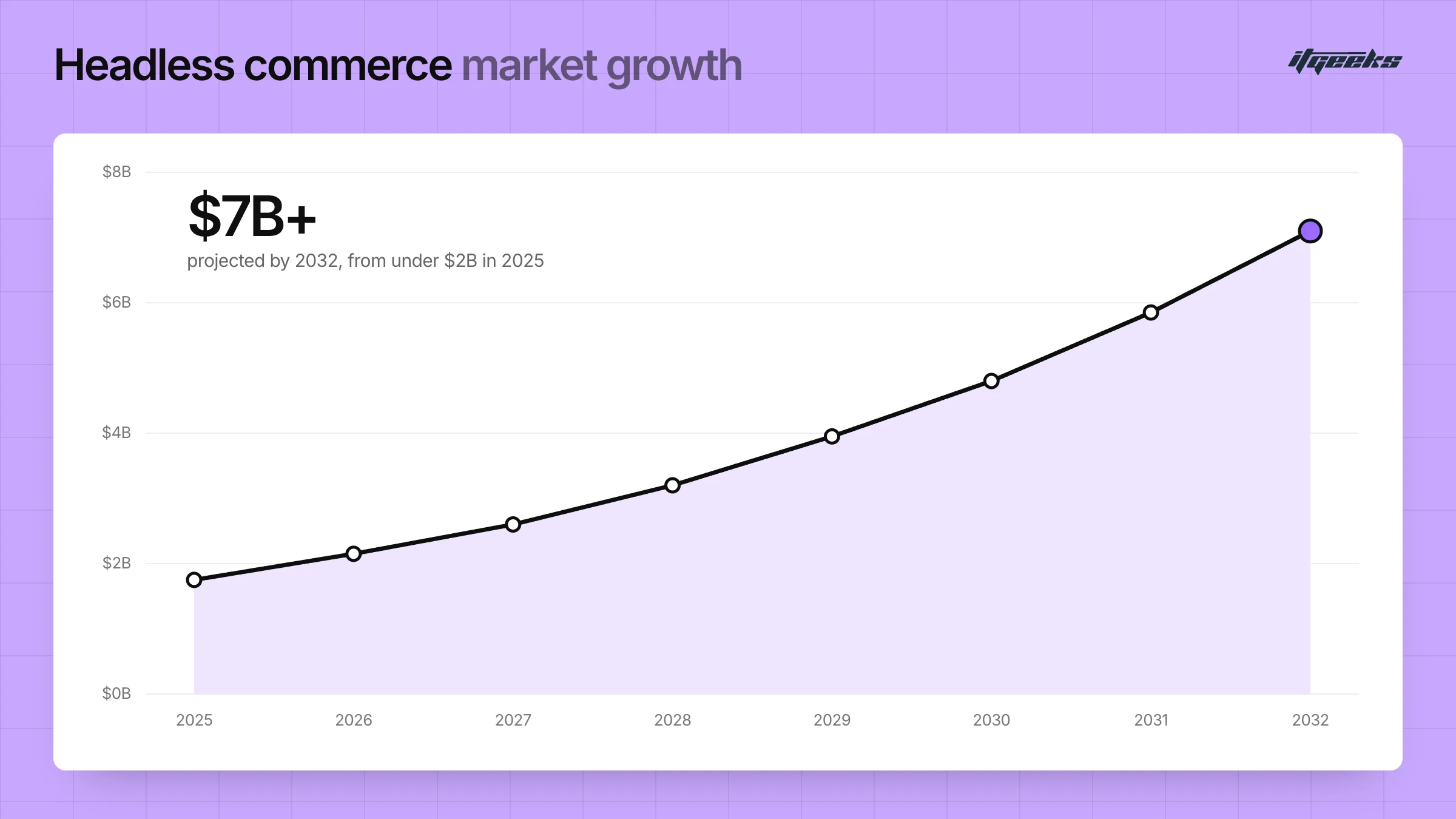
Headless Ecommerce, on the other hand, is like building a custom facade on top of a reliable, pre-built foundation. You keep all the plumbing and wiring Shopify provides, but you design the front however you want, faster, sleeker, more tailored to your brand.
How Shopify Plus Powers Headless Commerce
Shopify Plus is the perfect backend engine for headless because it handles everything that makes ecommerce run smoothly: inventory, payments, taxes, fraud protection, and secure checkout.
What headless lets you do is build your own customer-facing experience using modern web frameworks like React or Vue, hosted wherever you want, a global CDN for speed, or a platform tailored to your needs.
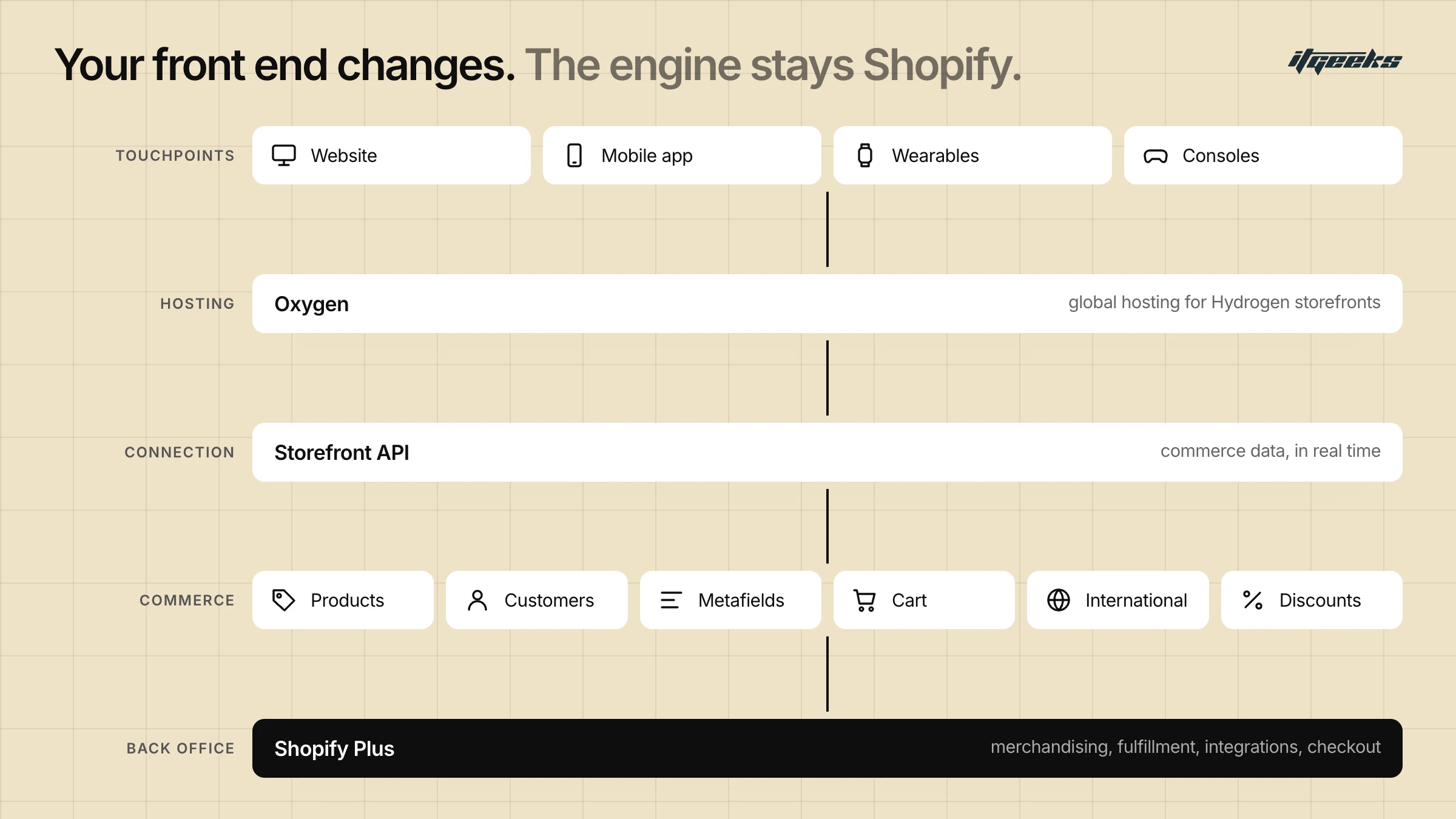
Shopify provides headless commerce APIs that let your custom front end talk directly to the backend in real time. The main one is the Storefront API, which serves products, collections, search, the cart and international pricing, and then hands customers off to checkout. The Customer Account API handles sign-in, orders and addresses. So, you get all the benefits of Shopify’s powerful infrastructure with the freedom to innovate on the front end.
One clarification worth making: headless is not exclusive to Plus. Shopify’s documentation says Oxygen hosting carries no extra charge on its paid plans, Plus included. Plus is simply where high-volume brands tend to land once their catalogue, markets and integrations get complex.
Shopify didn’t just jump on the headless trend, it built tools around it with their two in-house tools designed for this:
Shopify Hydrogen
A modern development framework built by Shopify to create customized storefronts. Hydrogen is built on React Router, an open-source React framework, with Shopify-specific components and utilities added on top. Picture Shopify delivering you a designer's toolkit optimized out of the box for performance (speed), flexibility, and scalability. Hydrogen was born to play well with Shopify's APIs, so you can create everything from a bare-bones store all the way through to an immersive, fully interactive shopping experience.
Shopify Oxygen
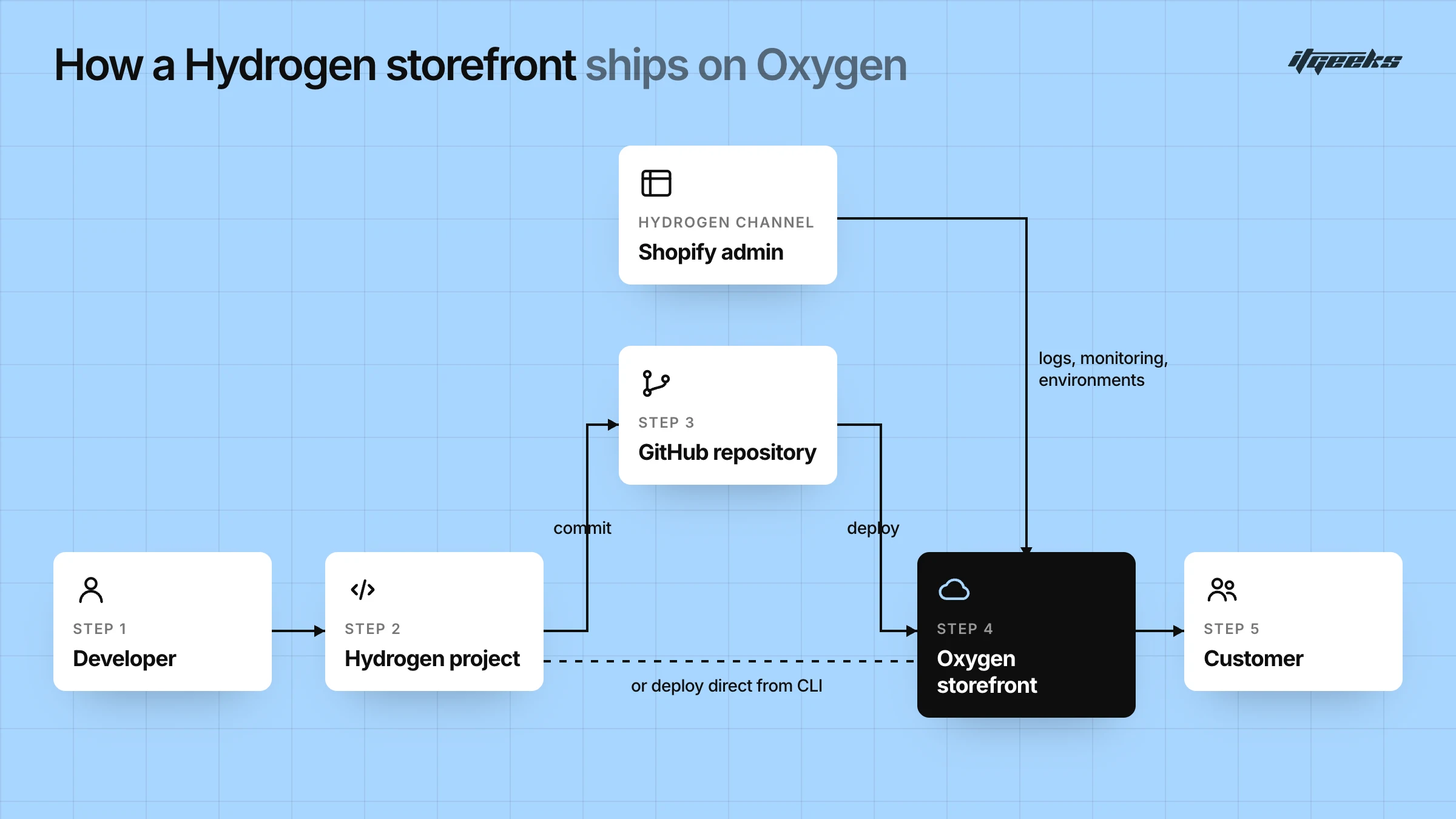
The global hosting platform for those Hydrogen storefronts. Instead of searching for a third-party hosting service and worrying about setup, speed, and uptime, Oxygen takes care of it all. It’s backed by Shopify’s infrastructure, meaning your site loads quickly for customers anywhere in the world, and security is baked in.
Per Shopify’s Hydrogen documentation (checked October 2026), Oxygen runs your storefront as serverless code at the edge, supports multiple preview environments, and deploys continuously from GitHub or your own CI/CD pipeline. You are not locked in, either: Hydrogen can also be self-hosted, and Shopify’s Headless channel lets you connect a storefront built with another framework, such as Next.js, hosted anywhere.
Together, Hydrogen and Oxygen remove the usual headaches of going headless, you get the freedom to create, with the safety net of Shopify’s ecosystem.
But…
Does My Store Need a Headless Structure?
Shopify Headless Ecommerce is a structural shift for businesses whose current setup is actively limiting their growth, whether that’s because of speed, design constraints, or the complexity of selling across multiple regions and channels.
But here is the thing - not every Shopify Plus store needs headless architecture. It’s ideal for stores that are:
Planning global expansion
Struggling with template limitations
Experiencing slow load times
Outgrowing the capabilities of traditional Shopify themes
It’s for the store that’s pushing against the edges of what Shopify’s traditional theme-based setup can deliver. For these brands, headless isn’t a luxury, it’s the only way forward without compromises.
When we’ve implemented Shopify plus Headless Commerce for high-volume merchants, we’ve seen it:
→ Cut load times by more than half, even under heavy traffic.
→ Enable fully localized storefronts for 10+ regions without fragmenting backend management.
→ Free marketing teams from template limitations, allowing them to roll out campaigns in hours, not weeks.
So the real question isn’t “Do you need headless?”
It’s: Are you planning to outgrow your current store in the next 12 to 24 months?
If the answer is yes, headless is not just worth considering, it might be the smartest investment you make.
Traditional Shopify vs Headless Shopify: What Actually Changes?
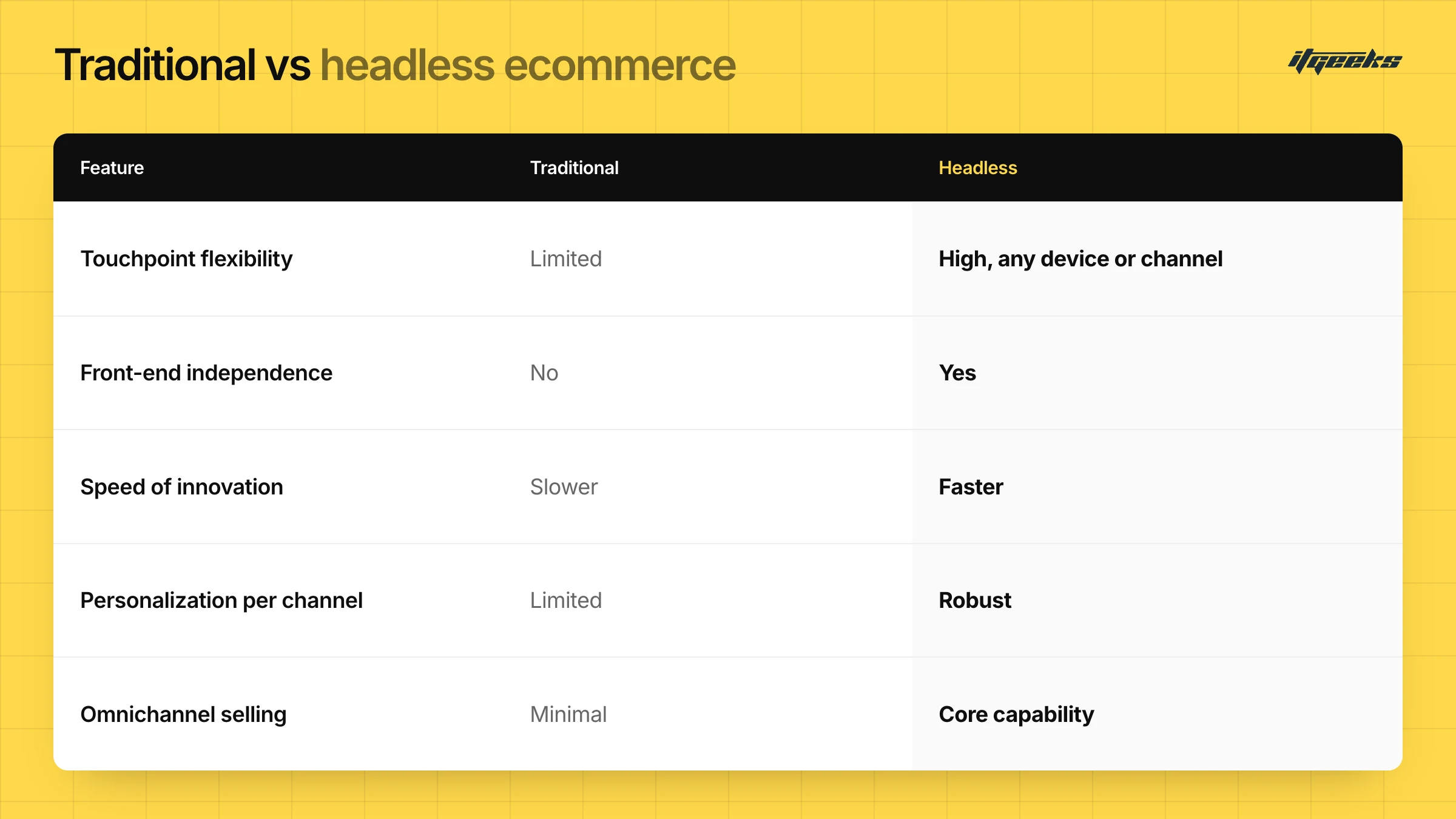
With a traditional Shopify store, a Liquid theme controls the storefront and Shopify hosts everything. With headless Shopify, you replace the theme with your own front end, while Shopify still runs products, inventory, orders and checkout. The table shows the practical differences.
| Area | Traditional Shopify (theme) | Headless Shopify |
|---|---|---|
| Storefront | Liquid theme and sections | Custom front end, for example Hydrogen or Next.js |
| Commerce engine and checkout | Shopify | Shopify (the cart is handed to Shopify’s checkout through the Storefront API) |
| Hosting | Shopify | Oxygen, or your own host |
| Design freedom | Within theme and section limits | Near-total control of the experience |
| Apps | Storefront apps install directly | Back-end apps work; storefront apps may need rebuilding |
| SEO basics (meta tags, canonicals, sitemaps) | Largely handled by the theme | Built and tested in your front end |
| Cost and upkeep | Lower | Higher, with an ongoing development team |
Let's look at the questions we, as a Headless Ecommerce agency, have been asked frequently by Shopify store owners.
What Benefits does Shopify Headless E-commerce Offer?
That’s a classic, and the most essential question.
Switching to a headless setup isn’t about chasing shiny tech trends; it’s about making a strategic choice that will directly impact revenue, operations, and brand experience.
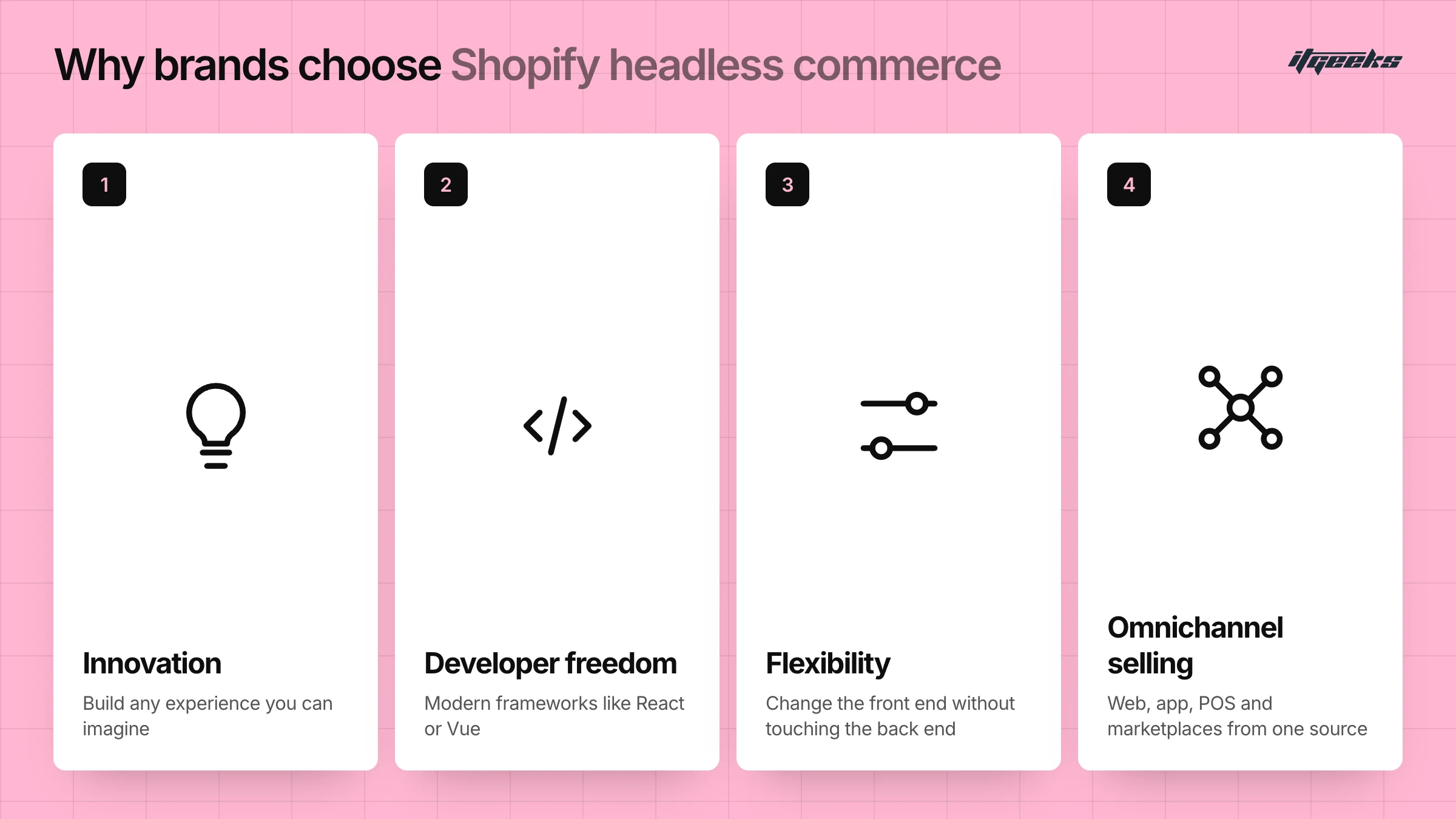
From what we’ve seen building headless stores for high-volume Shopify Plus merchants, here are the five benefits that matter most:
1. Speed That Pays for Itself
A fast site isn’t just “nice to have.” When your page loads in under two seconds, you retain more visitors, rank better on Google, and reduce drop-offs. The data tells no different story, the latest research report published by wpsteroids, states that websites with loading times of two seconds or less experience a 15% increase in conversion rates on mobile devices.
With headless, you can cut load times dramatically, even during heavy traffic from a product drop or ad blitz. Speed is not automatic, though: it comes from a well-built front end, so performance should be tested before launch, not assumed.
2. Freedom to Design Without Limits
Liquid themes can only stretch so far. Shopify headless commerce gives your design team the keys to build any experience they can imagine, immersive layouts, unique product pages, interactive storytelling, without bumping into Shopify’s template walls.
3. Global, but Local
One backend, many tailored storefronts. Headless ecommerce architecture makes it easy to run region-specific content, pricing, currencies, and languages without duplicating your store or adding complexity to your operations.
4. Built for Omnichannel
With Shopify Headless Ecommerce, your backend becomes the only source of truth, like a power-hub supporting your website, mobile app, POS, marketplaces, or even in-store experiences, all in sync. Meaning all your storefronts will be sharing the same inventory and order data.
In simple words: When you go Headless with Shopify Plus you get the stability of one of the best eCommerce engines in the world, and the freedom to innovate at your own pace.
Well, if that isn’t the best of both worlds, we don’t know what else is.
If I go for headless architecture, does it mean I am leaving Shopify?
Not at all, in fact, you’re leaning into Shopify even more.
With Shopify Headless Ecommerce architecture, you still use Shopify as your core engine, products, checkout, payments, and backend management stay exactly where they are.
The difference is that your storefront is powered by Hydrogen, Shopify’s React-based framework, and deployed on Oxygen, Shopify’s high-performance global hosting.
This gives you:
→ Complete creative freedom beyond theme constraints.
→ Lightning-fast storefront performance built for modern shoppers.
→ Git-based deployment through GitHub, with preview environments, and no servers of your own to run.
→ The Shopify back end, checkout and security you already rely on.
So you’re not leaving Shopify, you’re simply swapping the “default skin” for something built 100% for your brand, while keeping Shopify’s powerful backend intact.
How Shopify Headless Ecommerce enables adding multiple touchpoints?
The separation from front end to back-end means you are no longer limited to websites, you can connect your store to multiple touchpoints like:
Mobile apps,
Kiosks,
Smart devices,
Social media shops,
Voice assistants.
While the front-end is free to move any way you want, the back-end stays attached to Shopify Plus, holding the structure and the data together without any tech trouble for your team. For native apps in particular, see our mobile app development service.
Your backend remains the single source of truth, syncing:
Inventories
Orders
Customer data
Content
…all in real time across the touchpoints of your choice.
But do I need to be present on multiple touchpoints?
The short answer is - not all businesses NEED to be present on multiple touchpoints. But, if you are present as per your customers’ terms - you prioritise their needs, make the customer king again - and their trust is all yours.
Imagine you own a luxury retail business, your high-end customers would expect a seamless experience whether they’re browsing online on their phone, getting personalized recommendations through a mobile app, visiting a flagship store with interactive kiosks, or even shopping via social media.
Headless ecommerce makes all this possible by keeping the core operations centralized while letting brands customize each touchpoint for maximum impact.
Is Headless Ecommerce all about adding multiple touchpoints?
Not at all, and that’s actually one of the biggest misconceptions about headless commerce.
Multiple touchpoints (web, mobile apps, kiosks, smart devices, social commerce, etc.) are certainly one of the visible advantages, but they’re more like the “symptom” of headless, not the “cause.”
The real core is decoupling the frontend from the backend, meaning your presentation layer (what customers see and interact with) is independent from the commerce engine (Shopify in this case).
That separation allows:
→ Design and UX freedom far beyond Shopify’s Liquid theme limitations.
→ Custom performance optimization so pages load insanely fast across devices.
→ Specialized experiences for different audiences or geographies without duplicating your backend store.
→ Rapid experimentation, you can iterate on the frontend without risking backend stability.
Think of it this way: multiple touchpoints are a result of going headless. The real value lies in how much control you have over the experience, speed, and adaptability of your store, no matter where or how customers engage.
Now time for a biggie.
When we talk about Shopify headless ecommerce, the word “Global” often follows through. And that’s when we face the question -
How does Headless Ecommerce help my business in going global?
Headless helps you go global by letting one Shopify back end power several localized storefronts, each with its own language, currency, pricing, content and promotions. Shopify’s Storefront API returns market-specific prices when you pass a country, so each storefront shows the right currency without duplicating your store.
Expanding internationally isn’t just about translating your store into another language. It’s about creating tailored experiences that resonate deeply with customers in each market, and doing so at scale without increasing the complexities.
That’s where headless ecommerce architecture really stands out.
When your frontend is decoupled from Shopify’s backend, you can:
Build multiple localized storefronts from a single backend, each with unique languages, currencies, pricing strategies, product assortments, and promotions.
Easily comply with local regulations on taxes, shipping, and data privacy, all managed centrally in Shopify Plus but reflected accurately on each storefront.
Deploy region-specific marketing campaigns and content fast, without waiting for backend changes or store cloning.
Deliver faster load times worldwide by hosting storefronts on local CDNs or platforms optimized for each region, improving SEO and conversion rates.
In short, headless ecommerce helps you scale globally on your terms. And if you hire a Headless ecommerce agency, they can not only develop the infrastructure for you, but can also teach you how to manage your Shopify headless architecture once it goes live.
Why Multiple Storefronts Matter for International Expansion?
Doing business internationally isn’t the same as operating in one country. A classic example is McDonald’s. When they expanded overseas to India, their flagship product, the beef burger, was not a fit for the market.
Why? Because a large part of the population doesn’t eat beef. McDonald’s adapted by introducing the McAloo Tikki and Paneer wraps.
The result? These offerings were widely accepted, helping McDonald’s become one of the most successful food chains in India. Similarly, in Japan, you’ll find Teriyaki Burgers and Matcha desserts. These aren’t just marketing gimmicks; they reflect deep local consumer insights and preferences.
Even though you’re not selling food, the principle is the same: your international customers aren’t the same as your domestic ones. What works in one market may fall flat, or even confuse buyers, in another.
With Shopify Plus and headless commerce, multiple storefronts allow you to:
Tailor product offerings to match local preferences and regulations.
Adjust pricing, taxes, and promotions per region without affecting your global operations.
Localize content and UX, from language and imagery to marketing messages that resonate culturally.
Support regional payment methods and shipping options, ensuring a smooth checkout experience for every market.
In short, multiple storefronts aren’t just a “nice-to-have” for global expansion; they’re essential to delivering relevant, frictionless experiences that convert. Without this level of customization, even the strongest brands risk losing credibility, sales, and customer loyalty abroad.
Can I set different prices for different regions based on customs, tariffs, etc.?
Yes. Headless architecture lets you tailor prices based on local customs, tariffs, and purchasing power. With Shopify APIs, you can dynamically adjust prices as global economic conditions change, keeping your business competitive worldwide.
With the world’s dynamics shifting rapidly, we’ve been getting one question more than ever: In such an unpredictable economy, how will my store survive in the international setup?
And here is how Shopify Headless Ecommerce architecture make it happen -
Dynamic Tax-Inclusive Pricing: Shopify allows you to automatically include or exclude taxes in your product prices based on your customer's region. This ensures compliance with local tax expectations and simplifies the shopping experience for international customers.
Custom Pricing by Market: You can set specific prices for different countries or regions, accounting for factors like tariffs, shipping costs, and local taxes. This flexibility helps maintain competitive pricing and profitability across diverse markets.
Real-Time Duty Calculations: By integrating with tools that calculate duties and import taxes at checkout, you can provide transparent pricing to customers, reducing surprises at delivery and enhancing trust.
Adaptation to Trade Policy Changes: The global trade environment is continually evolving, with new tariff structures and compliance requirements affecting cross-border commerce. Shopify's tools enable you to adjust your pricing strategy swiftly in response to these changes, ensuring your business remains competitive and compliant.
In summary, Shopify Plus offers robust features that allow you to set and manage regional pricing dynamically. By leveraging these tools, you can navigate the complexities of international trade, ensuring your pricing strategy aligns with current economic conditions and regulatory requirements.
To understand how to operate business in fluctuating tariffs, a must read by Shopify - International Import Shipping: 2026 Tariff Guide.
A strategic decision is taken with evaluating all the possible options. If you are a business owner, you must be wondering:
What If I Don’t Go Headless and Try Multiple Stores, Will It Hurt My Revenue or SEO?
The short answer is - Yes, it can - if not handled carefully.
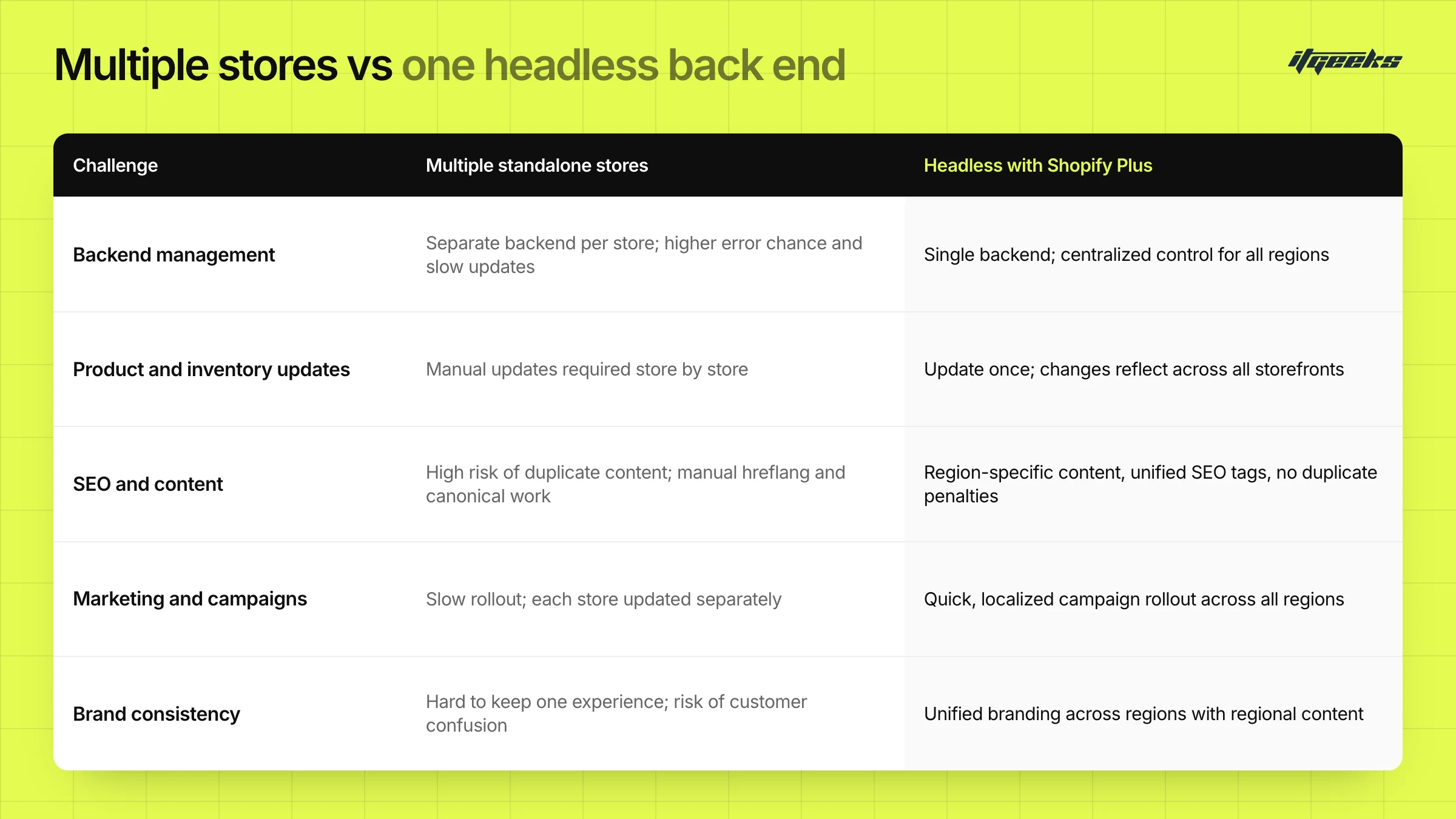
Without headless architecture, running multiple stores often means duplicating your backend for each region. This introduces several risks:
Operational Complexity: Managing inventory, orders, and products across multiple stores can become a logistical nightmare. Mistakes are more likely, slowing fulfillment and frustrating customers, ultimately hurting revenue.
SEO Challenges: Search engines may see similar content across stores as duplicate content, negatively impacting rankings. You also have to manage hreflang tags, canonical URLs, and backlinks manually.
Slower Iterations: Any design or marketing change needs to be implemented separately for each store, slowing down campaigns and innovation.
Inconsistent Branding: Without a centralized backend, UX, messaging, and pricing can drift across regions, confusing customers and lowering trust.
How Headless Commerce Solves This:
Headless commerce flips this problem on its head. With Shopify Plus as a single backend, you can manage all products, inventory, and orders centrally while still delivering multiple customized frontends for each region.
Streamlined Operations: Update a product or price once, and it automatically reflects across all storefronts. No duplication, no mistakes.
SEO-Friendly, Region-Specific Content: Each storefront can have unique content, meta tags, and URLs, avoiding duplication penalties while still pulling from the same backend.
Faster Campaigns and Iterations: Marketing teams can roll out updates or promotions tailored to each region without waiting for backend changes or managing separate stores.
Consistent Branding Everywhere: Even with localized experiences, the brand stays coherent globally, keeping customer trust high.
In short: Multiple standalone stores can be a nightmare, headless commerce turns that complexity into an organized, scalable, and efficient system, letting you focus on growth rather than firefighting operations.
Usually Shopify store owners are wearing multiple hats at once and adding one more for maintenance seems like a lot and hence comes a question-
If I Have Multiple Frontends, Won’t It Be Difficult to Manage?
It might sound like managing three different Shopify Plus stores. But in reality it isn’t. That’s the beauty of Headless Ecommerce.
With Shopify Plus as your single backend, you can manage all products, inventory, orders, and pricing in one place, even if you have multiple frontends for different regions, languages, or devices.
Streamlined Operations: Update products or pricing once, and it automatically reflects across all storefronts. No duplication, no mistakes.
Faster Rollouts: Launch marketing campaigns, promotions, or new products region-specifically without duplicating effort.
Consistent Branding: Even with region-specific designs, your brand experience remains unified.
What About CDN and CMS? Will It Still Be on Shopify Plus?
Yes, and here’s where headless commerce is often misunderstood.
Going headless doesn’t strip away Shopify Plus; it actually keeps Shopify’s infrastructure at the core.
CDN (Content Delivery Network): Oxygen integrates with Shopify’s CDN, so your storefront and backend assets are served fast, securely and at scale. If you self-host your front end, you choose the CDN yourself.
CMS (Content Management System): Your product data, inventory, checkout, and core eCommerce operations remain in Shopify Plus. What changes is the presentation layer. For content-heavy or marketing-driven pages, you can connect a CMS like Contentful, Sanity, or Strapi, giving your marketing team greater flexibility without touching your backend.
In essence, Shopify Plus still powers the commerce engine, while your chosen frontend and CMS control the storytelling layer. It’s the best of both worlds, Shopify’s reliability with your own creative and operational freedom.
Now it’s time for a bold question.
If the Work Is Happening Outside Shopify Plus, What Are We Paying Shopify Plus For?
Every time we get this question we know the business owner is making smart choices. So here is our answer.
Shopify’s value in headless isn’t the front end, it’s the entire commerce engine running behind the scenes.
In the traditional Shopify setup → Shopify gives you both the “storefront” (Liquid theme) and the “back end” (products, orders, checkout).
In headless → You replace Shopify’s storefront with your own, but keep everything else Shopify is famous for:
Product management
Order processing
Secure checkout
Multi-currency
Payment gateways
Taxes and tariffs
Inventory syncing across channels
API access to all that commerce data
It’s like buying a Tesla but swapping the body for your own custom-designed shell, the motor, battery, software, and autopilot are still Tesla’s, you’re just changing the look and feel.
Why Shopify Plus Still Makes Sense in Headless:
You get Plus-level capacity for the back-office side: Admin API limits vary by plan, and your integrations (ERP, OMS, inventory) lean on them. Real shopper traffic to the Storefront API is not subject to a fixed request-per-minute limit, per Shopify’s API documentation.
You get Shopify Markets for easy global pricing, taxes, and currencies.
You can still plug into Shopify Payments, POS, and apps.
You don’t have to build your own checkout, Shopify handles the secure, PCI-compliant checkout flow. Your front end builds the cart through the Storefront API and hands the customer to Shopify’s checkout.
Headless simply lets you redesign the driver’s experience while still relying on Shopify Plus for the driving power.
Is going headless worth the investment for my business size?
If you’re a small business with a simple catalog and minimal traffic, the development cost and complexity might outweigh the benefits for now. A well-optimized Shopify theme can get you fast load times, a beautiful design, and easy management without the extra overhead.
But if you’re a mid-to-large business (or growing fast), headless can be worth every dollar, giving you:
Unmatched scalability for sudden traffic spikes (think holiday sales).
Full creative control without being bound by theme limitations.
Multi-touchpoint presence, web, mobile app, smart screens, all managed centrally.
Faster global delivery thanks to CDN-powered setups.
In short, if you’re hitting the ceiling with your current setup, headless isn’t just worth it, it’s the natural next step.
How much does Shopify headless cost?
A headless Shopify build costs more to build and run than a theme-based store, because you are building and maintaining a custom front end. Shopify’s developer documentation says as much. The exact figure depends on scope, so a fixed price is only meaningful after discovery.
The main cost factors we scope on a Shopify headless project are:
Storefront scope: number of templates, custom features, and design complexity.
Markets and languages: how many localized storefronts you need.
Integrations: CMS, search, reviews, subscriptions, ERP and OMS connections.
App replacements: storefront apps that must be rebuilt for the new front end.
Hosting: Oxygen has no extra charge on Shopify’s paid plans, while self-hosting adds infrastructure cost.
Ongoing maintenance: framework upgrades, API version updates and new features, usually handled by a developer retainer.
If you want a number for your own store, our team can scope it with you on a strategy call, and our Shopify retainer plans cover the maintenance side.
What are the challenges of going headless with Shopify?
The main challenges are a heavier reliance on developers, longer initial build timelines, and more to maintain. Shopify’s own headless guide lists these trade-offs, and we see the same ones in practice:
Greater reliance on engineering resources for implementation and changes.
Longer timelines for the first build and for some updates.
Responsibility for maintaining front-end infrastructure and API versions.
More architectural decisions across the stack, from CMS to search.
Possible unnecessary complexity for smaller teams or simple catalogues.
None of these is a reason to avoid headless if you genuinely need it. They are the reason to plan it properly, with a team that has built headless storefronts before.
Who handles updates or bug fixes in a headless setup?
In a headless setup, updates and bug fixes don’t “just happen” automatically the way they do with a standard Shopify theme.
They’re handled by:
Your development team or headless ecommerce agency: You can find a Shopify Partner from the Shopify partner directory, and select from a wide range of partners based on their expertise, portfolio, and partner tier, such as Shopify Platinum Partner - the highest partner tier in the partner ecosystem.
They maintain the front-end (Hydrogen, custom React/Vue, etc.) and make sure it stays compatible with your back-end.Shopify: They update the Shopify back-end (checkout, orders, products) automatically, so you don’t have to worry about that part.
Third-party service providers: If your headless build uses external integrations (search, CMS, CDN, analytics), each has its own update cycle, your dev team ensures everything works together after those updates.
Tip: Many brands on Shopify Plus choose to keep a retainer with a trusted partner, like ITGeeks, a Shopify Platinum Partner, so updates, bug fixes, and new feature requests are handled quickly without downtime or frantic troubleshooting.
Will my current Shopify apps work, or do I need custom solutions?
Most Shopify apps are built for a traditional Shopify storefront, so when you go headless, things can change. Some apps will work just fine, especially those that run in the backend (like inventory management or email marketing tools). But apps that control what your customers see on the storefront, think reviews, upsell pop-ups, or live chat, may need to be re-integrated or rebuilt to work in your new setup.
That’s why it helps to work with an experienced Shopify Plus Agency. They know which apps can plug right into a headless architecture, which ones need custom Shopify Storefront API work, and when it’s smarter to create a tailor-made solution. These agencies can keep the features you love, but make sure they work seamlessly with your faster, more flexible headless store. For a wider look at apps, see our guide to Shopify’s app store.
Can my store handle high traffic events like sales or Black Friday?
Yes, a well-built headless store can handle high-traffic events like Black Friday, and this is one of the biggest advantages of choosing Shopify headless commerce. Shopify’s API documentation says real buyer traffic to the Storefront API is not subject to a fixed request-per-minute limit, though checkout creation is throttled.
Because your storefront and backend are decoupled, heavy traffic during events like Black Friday or flash sales is spread across the front end and the commerce engine, rather than one theme doing all the work. The front-end can handle thousands of simultaneous visitors while the backend processes orders seamlessly.
With the right setup, you can run load tests, optimize hosting, and monitor performance to ensure customers enjoy smooth browsing and checkout, no matter how busy things get. Our BFCM readiness checklist covers what else to review before peak season.
Is headless Shopify good for SEO?
Headless Shopify can be good for SEO, but it is not automatic. A theme-based store gets meta tags, canonicals, structured data and sitemaps largely out of the box, while a headless front end has to deliver them itself. Done well, with server-rendered pages and fast load times, it can match or beat a theme.
Here is what to get right:
Render critical content on the server, so crawlers see full HTML. Check the raw HTML response, not just the browser view.
Set titles, meta descriptions and canonical URLs for every route. Hydrogen includes a getSeoMeta utility for titles, descriptions, canonicals and JSON-LD, and strips query parameters from canonical URLs by default.
Generate sitemap.xml and robots.txt routes. The Hydrogen base template includes both.
Emit Product structured data in the server response rather than only after the page loads in the browser.
Keep URLs and redirects stable when you migrate to headless. Our guide to maintaining SEO rankings during a Shopify Plus migration applies here too.
Headless commerce vs composable commerce: what’s the difference?
Headless commerce separates the storefront from the commerce back end. Composable commerce goes further, assembling the whole stack from specialist services, such as search, CMS, payments, tax and fulfilment, connected through APIs. Headless is often the first step toward composable, and a store can be headless without being fully composable.
For most Shopify brands, the practical path is to keep Shopify as the commerce engine and checkout, build a headless front end, and add specialist tools such as a headless CMS or search only where they earn their place. Every extra service adds integration and maintenance work, so add them deliberately.
Switching from traditional to headless ecommerce architecture is a strategic move, and we hope this guide has answered all the questions you were looking to find answers for.
But if you’ve got more questions, our experts can walk you through whether headless is the right fit for your business, what it might cost, and how to make the transition seamless. No pressure, just honest advice.
Talk to our experts today, click here.
Quick Recap: Shopify Headless Ecommerce in 45 Seconds
What is Shopify headless ecommerce?
Shopify headless ecommerce is when your store’s design (frontend) is completely separated from its engine (backend), allowing customizable, faster, and scalable shopping experiences.
What Benefits Does Shopify Headless E-commerce Offer?
While Headless Shopify offers many benefits, speed, creative freedom, scalability, and the flexibility to sell anywhere, all while keeping Shopify’s reliable backend, tops the list.
If I Go for Headless Architecture, Does It Mean I’m Leaving Shopify?
No, you still use Shopify’s backend for products, orders, and payments. Headless simply swaps out the storefront layer.
Does Headless increase speed?
It can. Decoupled frontends can load faster and scale independently of backend traffic, but the result depends on how well the front end is built and tested.
Will my apps still work?
Most backend apps work, while some frontend features may need headless-compatible solutions.
Can I run multiple regions?
Yes, headless allows multiple storefronts from a single backend, supporting localized pricing, languages, and content.
Will Headless make managing my store more complicated?
Not necessarily. A well-built headless setup centralizes inventory, orders, and content, so updates happen in one place.
How much does Shopify headless cost?
More than a theme-based store, because you build and maintain a custom front end. Scope, markets, integrations and ongoing maintenance drive the price.
Is headless Shopify good for SEO?
It can be, if pages are server-rendered and meta tags, canonicals, structured data and sitemaps are built into the front end.
Is headless the same as composable commerce?
No. Headless separates the storefront from the back end; composable assembles the whole stack from specialist services.
Our two cents
If you’re planning big moves or feeling limited by your current platform, it’s time to consider Shopify headless architecture. The brands we’ve worked with have seen tangible gains in speed, control, flexibility, performance, and revenue after the switch. Why? They understood their needs, chose the right tech stack, and worked with experts who could execute flawlessly, transforming headless commerce from a buzzword into a real growth driver
If you’re looking for a Shopify headless eCommerce development agency, you’ve just found one. At ITGeeks, we’ve supported 10,000+ brands through every stage of their journey, from development and migration to headless builds and digital marketing. Whatever your Shopify needs, we have the expertise to make it happen.