

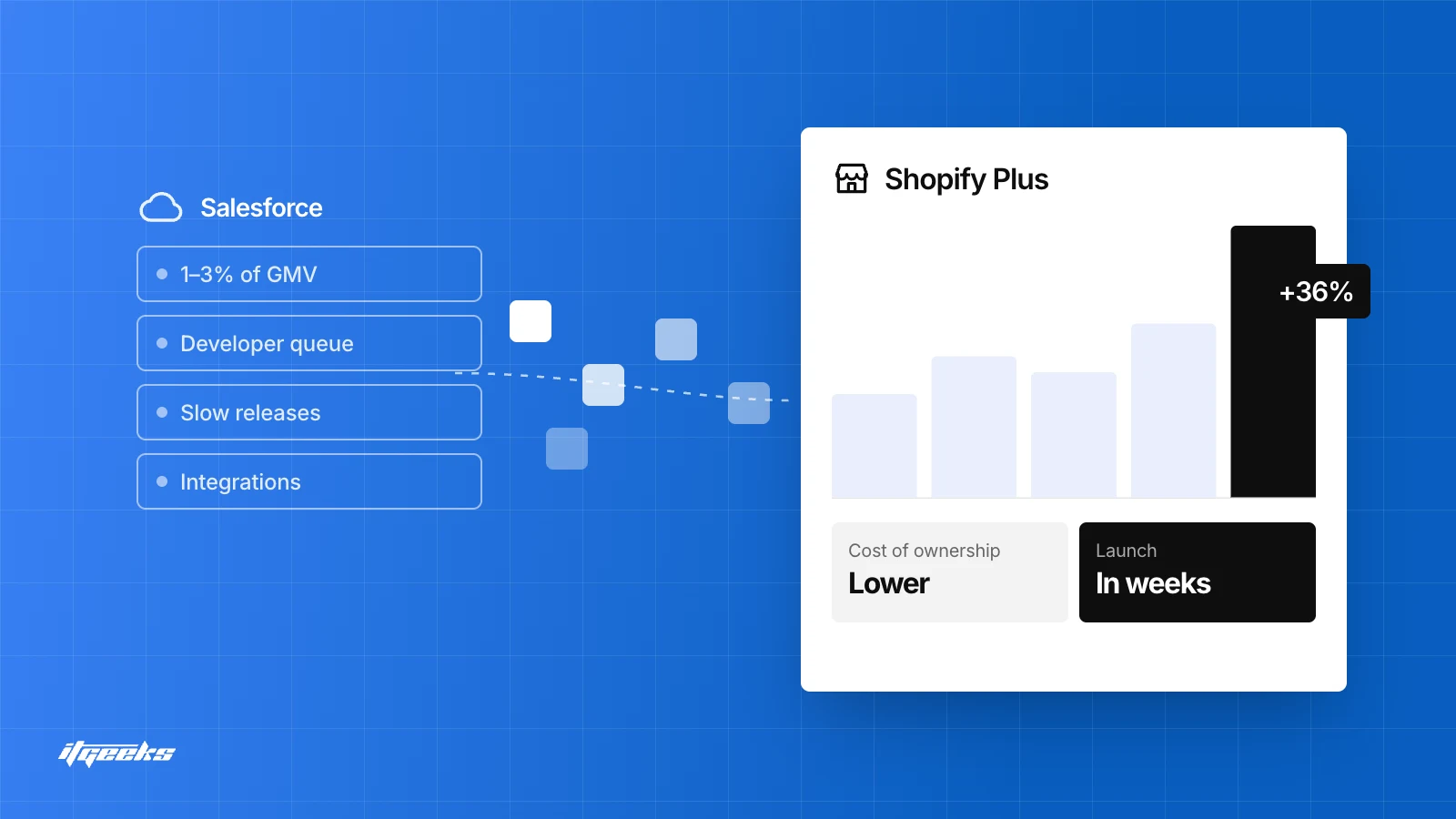
“You buy a platform thinking that is what you need to do to scale, but what you don’t necessarily know is the associated costs that go with that, not only the costs of getting onto a massive platform.”
These words from The Cambridge Satchel Company’s owner, who decided to migrate from Salesforce Commerce Cloud to Shopify Plus (read their case study), capture the very reason why so many brands are rethinking their E-commerce platforms today. The owner quoted is founder and CEO Julie Deane, and the move took place in 2017, according to Shopify’s case study.
The complexities, the fees, and the limited agility are just a few of the reasons why a platform once seen as the go-to choice for fast-growing brands is now being left behind in favor of Shopify Plus.
And these are only a few of the reasons. Global names like Decor Steals, MZ Wallace, Bauer, and many others are choosing to migrate from Salesforce Commerce Cloud to Shopify Plus for its scalability, flexibility, and cost-efficiency. Decor Steals, MZ Wallace and Bauer appear as case studies on Shopify’s Salesforce Commerce Cloud comparison page.
The short answer: brands move from Salesforce Commerce Cloud (SFCC, formerly Demandware) to Shopify Plus mainly for three reasons: a checkout that Shopify’s own research says converts up to 36% better, a lower total cost of ownership (up to 35% lower in Shopify-commissioned research), and a faster, less developer-dependent way to ship changes. Below we explain each reason, what the migration involves, and when staying put can still make sense.
Before diving deeper into why this shift is happening, let’s start with the basics.
What Is Salesforce Commerce Cloud? A Brief Salesforce Commerce Cloud Overview
Salesforce Commerce Cloud is an enterprise E-commerce platform designed for large retailers that need advanced customization and scalability. Salesforce describes it as a suite of five products: B2C Commerce, B2B Commerce, Order Management, Payments and Point of Sale. The B2C Commerce product is the platform many teams still call Demandware.
At first glance, it seems like a great choice for businesses, offering powerful integrations and global reach. But over time, many retailers realize the hidden drawbacks, such as high licensing costs, longer development timelines, and a heavy reliance on technical teams, that begin to cut into their revenue pipeline.
These challenges are a key reason why so many brands eventually migrate from Salesforce Commerce Cloud to Shopify Plus, which offers the same enterprise-level power while adding the agility, flexibility, and cost-efficiency modern businesses need.
What Is Shopify and Shopify Plus? A brief Overview
Shopify is a leading cloud-based E-commerce platform that enables businesses of all sizes to create, manage, and scale online stores without the hassle of hosting, server maintenance, or software upgrades. Its ease of use, mobile accessibility, and vast app ecosystem have made it the go-to platform for millions of merchants worldwide.
Shopify Plus is the enterprise-level solution built on Shopify’s core strengths, but tailored for fast-growing and high-volume brands. It provides advanced Shopify Plus features like a fully customizable checkout, automation through Shopify Flow, international storefronts, dedicated account management, and API access, giving enterprises the flexibility to scale globally while maintaining ease of use. Shopify’s Plus materials describe a dedicated Merchant Success Manager, though availability can vary, so confirm what your agreement includes. Shopify’s plan page also lists priority 24/7 phone support, expansion stores, unlimited B2B catalogs and higher API rate limits on Plus.
It is also the perfect backend engine for headless commerce, as it handles everything critical to smooth E-commerce operations: inventory, payments, taxes, fraud protection, and secure checkout. Shopify lists up to 25 headless storefronts on the Plus plan.
Features | Shopify | Shopify Plus |
Best For | Startups & SMBs | Enterprise & high-growth brands |
Hosting | Fully cloud-based | Fully cloud-based |
Checkout | Standard | Fully customizable |
Automation | Limited | Advanced (Shopify Flow, Functions) |
Support | 24/7 basic | Priority + dedicated manager |
Read more at https://www.shopify.com/plus. See current plan details on Shopify’s pricing page.
A note for teams moving from older setups: Shopify Scripts, the old way to customize Plus discounts and checkout logic, were deprecated on June 30, 2026. Their replacement is Shopify Functions (or a public app), so a migration today builds on Functions and Checkout Extensibility from day one. See Shopify’s changelog for details.
In short, Shopify Plus brings enterprise-grade power to the familiar Shopify environment, making it a more agile and cost-effective alternative to legacy cloud commerce platforms like SFCC.
What brands are on Shopify Plus?
Shopify Plus powers some of the world’s most recognizable and high-performing enterprise brands. From global startups to established leaders, the platform enables businesses to scale quickly, operate internationally, and experiment without limits. Not every brand below came from Salesforce Commerce Cloud; the list shows the range of businesses the platform supports.
Leading Brands Across Industries
Some of the major brands using Shopify Plus include: Tesla, Budweiser, MVMT, Kylie Cosmetics, Decathlon, Rare Beauty, Westside, Jennifer Aniston’s LolaVie, Gymshark, Heinz, Allbirds, and more.
Industries like Food & Beverage and Apparel are leading the adoption of Shopify Plus, with multiple global brands leveraging the platform to grow their online presence.
Notable Case Studies
Here’s how Shopify Plus has helped fast-growing brands achieve massive results:
The Cambridge Satchel Company: Moved from Salesforce Commerce Cloud to Shopify Plus in 2017. According to Shopify’s case study, integrations that once cost around £30,000 each became simple plugin setups, and the core team can now run the store with little outside development help.
Decor Steals, MZ Wallace and Bauer: Shopify’s Salesforce comparison page reports that Decor Steals replatformed for about $300,000 less, MZ Wallace’s conversion rose 40%, and Bauer’s rose 18%.
Kylie Cosmetics: Generated $420M in just 18 months, including $10M in sales in a single day.
MVMT: Grew from a startup to $71M in revenue over four years and was later sold for up to $200M.
Decathlon: Manages E-commerce for over 1,750 stores worldwide, handling complex operations efficiently.
The Kylie Cosmetics, MVMT and Decathlon figures are as reported by Shopify and the brands, and we have not independently verified them. Results vary by brand, and these figures come from vendor and brand-reported case studies rather than independent audits.
These examples highlight why enterprise and high-volume merchants choose Shopify Plus, not just for its features, but for the freedom to move fast, scale globally, and innovate continuously.
Read more at here. You can also see our own case studies.
What new merchants joined Shopify Plus recently?
Shopify does not publish a dated list of the merchants that joined Shopify Plus most recently, so any “new this month” list would be a guess. Shopify’s own Shopify Plus customer stories feature brands such as Everlane, Brooklinen, ButcherBox, Arhaus, Ruggable, Carrier, Dollar Shave Club, Lull and Allbirds, and Shopify’s comparison page for Salesforce shows brands that replatformed from SFCC. To see who has moved from your current platform, check those pages and our case studies.
Salesforce vs Shopify Plus
As a Shopify Platinum Partner, we’ve helped brands make the move from Salesforce Commerce Cloud to Shopify Plus. Why are so many businesses switching? The reasons are clear: higher conversion rates, lower total cost of ownership, faster innovation, and the ability to scale more efficiently.
Here’s a closer look at the key factors driving these migrations:
Factor | Salesforce Commerce Cloud | Shopify Plus |
Pricing model | Percentage of gross merchandise value (GMV); rates are not published | Subscription on a 1- or 3-year term |
Product structure | Suite of five products: B2C Commerce, B2B Commerce, Order Management, Payments, Point of Sale | One platform with native B2C, B2B and POS tools |
Headless | Headless options available for B2C Commerce | Up to 25 headless storefronts on the Plus plan |
B2B | Separate B2B Commerce product | Unlimited B2B catalogs on the Plus plan |
Sources: Salesforce Commerce Cloud, Salesforce commerce pricing and Shopify pricing. If headless is on your roadmap, our guide to Shopify headless ecommerce explains the trade-offs, and our guide to B2B on Shopify Plus covers wholesale.
Shopify Converts Better
Shopify consistently outperforms Salesforce Commerce Cloud in checkout conversions, by up to 36%.
That figure comes from a study completed in April 2023 with one of the Big Three global management consulting firms. Shopify commissioned the study, so treat it as a vendor claim and test it against your own checkout data.
A data-backed study conducted in partnership with one of the Big Three global management consulting firms, and commissioned by Shopify, reported that Shopify outperformed major competitors, including Salesforce, by an average of 15% in checkout conversions. We could not find the 15% average on Shopify’s public pages, so the 36% “up to” figure is the one to rely on. For enterprise brands, even a 1% lift can translate into millions of dollars in additional revenue.
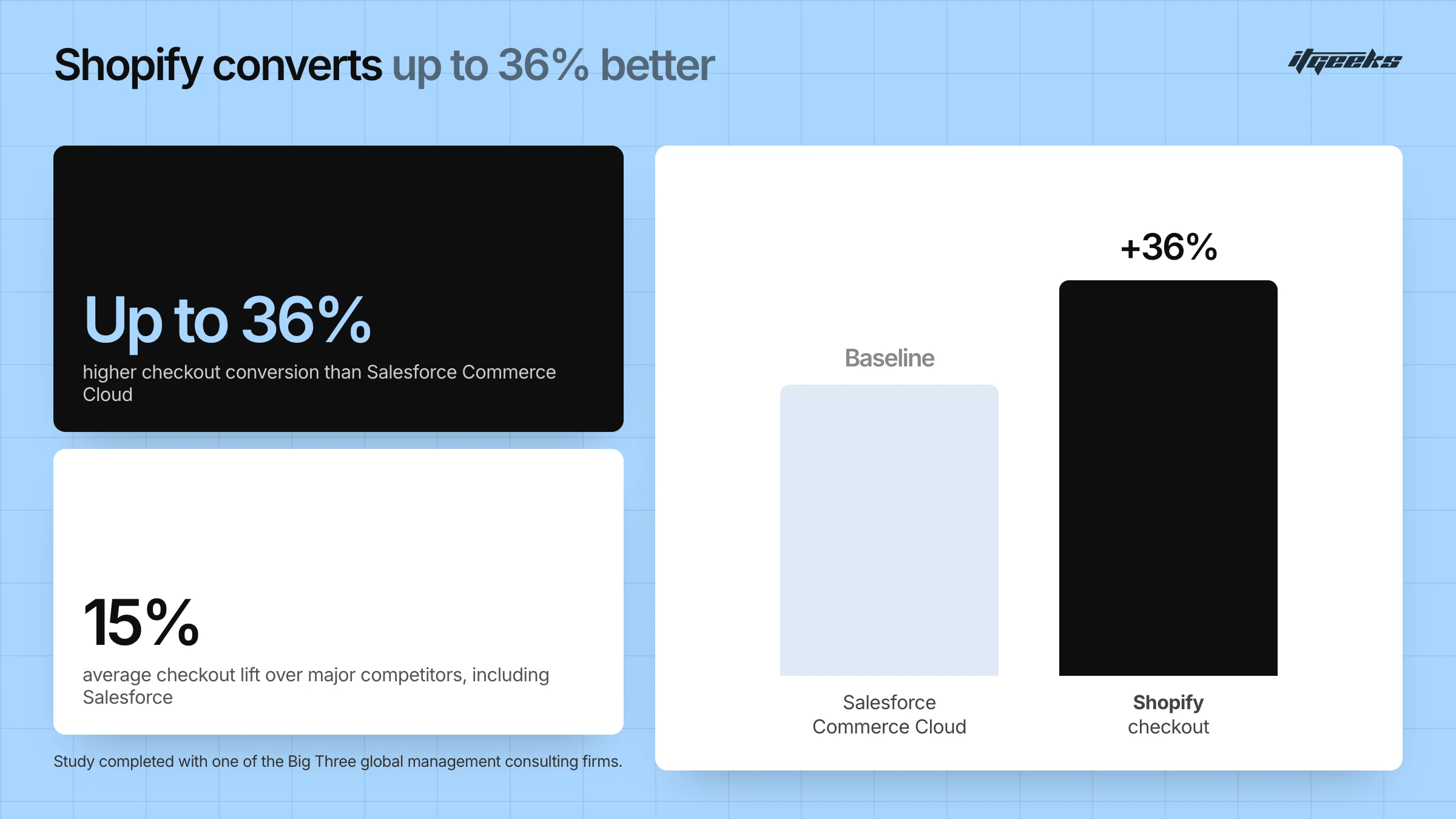
Bar chart illustrating checkout performance, highlighting Shopify's 36% higher conversion rate over Salesforce Commerce Cloud.
Why Shopify drives better conversions:
Integrate digital wallets like Apple Pay in clicks, not months.
Customize checkout appearance and workflow. On Plus this is done with Checkout Extensibility and Shopify Functions.
Extend or replace backend functionality easily.
Collect rich customer data to optimize marketing and sales.
Checkout also benefits from Shop Pay. During Black Friday Cyber Monday 2025, Shopify reported that 32% of orders on Shopify-powered stores were placed with Shop Pay.
Lower TCO and Higher ROI
When you migrate from Salesforce Commerce Cloud to Shopify Plus can reduce total cost of ownership by up to 35% compared to Salesforce Commerce Cloud.
That figure comes from Shopify-commissioned research by an independent consulting firm, conducted between November 2023 and February 2024 in North America, which found platform costs 14% higher and operating costs 6% higher on Salesforce. See the Shopify comparison page for the footnotes.
Key cost advantages:
Lower licensing fees: The plan starts at $2,300/month, including enterprise-level features. Salesforce licensing often costs 1-3% of gross merchandising value. Treat both as indicative: $2,300 USD on a three-year term is the figure agencies commonly quote (confirm on Shopify’s pricing page), and Salesforce prices commerce on a percentage of GMV without publishing its rates, so 1-3% is a third-party estimate.
Affordable development: Shopify developers are widely available, allowing brands to choose partners based on budget, expertise, and portfolio.
Reduced dependency on developers: Business users can take more control, reducing ongoing maintenance costs.
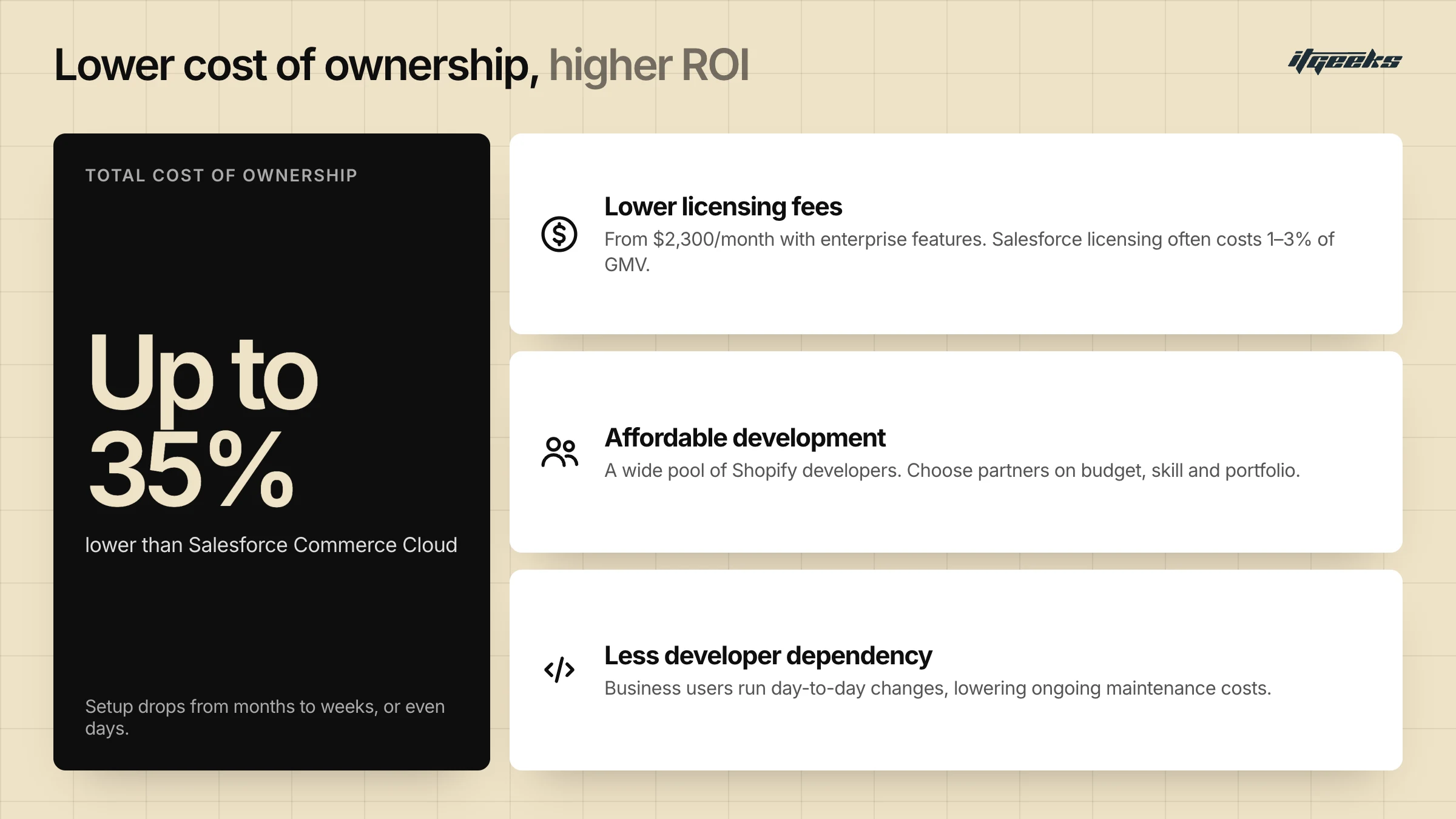
Chart showing the lower total cost of ownership when you migrate from Salesforce Commerce Cloud to Shopify Plus.
Implementation speed:
Shopify can reduce setup time from months to weeks, enabling faster go-to-market and revenue growth.
An EY “Time to Value” report (October 2025, 300+ organizations), cited by Shopify, found brands migrating from Salesforce implemented 22% faster, were 2.5 times more likely to launch on time and 1.5 times more likely to stay on budget. Shopify commissioned the research.
Revenue-driving features:
Point of Sale (POS)
Managed Markets, which Shopify says serves 175+ countries
Shop Pay & Shop Pay Installments
Shopify Audiences
The Shop App
These features help enterprise brands increase sales, optimize operations, and scale globally without the limitations often encountered on Salesforce Commerce Cloud.
Faster Innovation with Shopify Plus
This platform is built for businesses that want to scale quickly, offering native tools for B2C, B2B, and retail, all on a unified infrastructure.
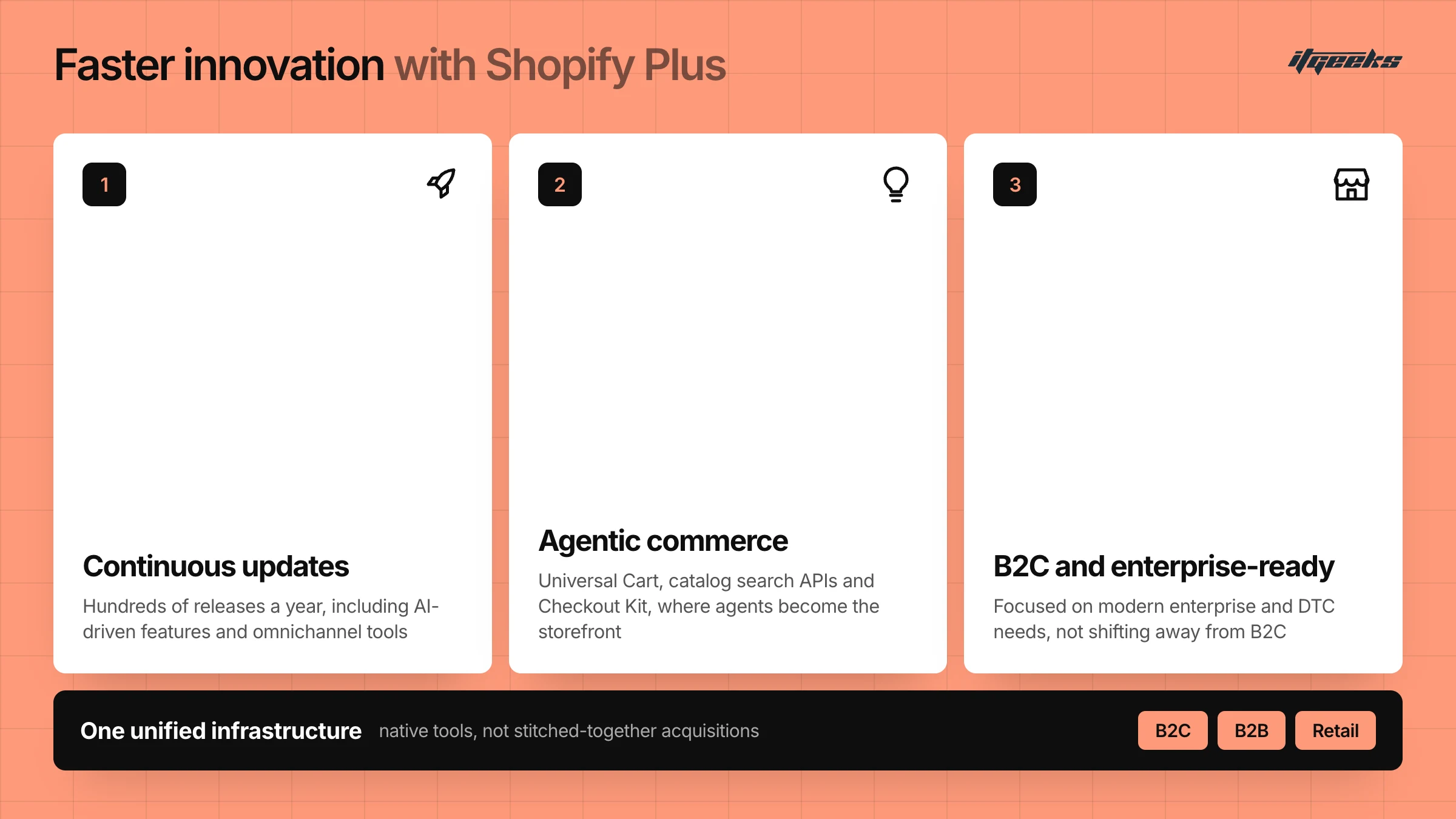
Chart showing faster innovation with Shopify.
In contrast, Salesforce Commerce Cloud was assembled through multiple acquisitions, creating a platform with mixed architectures. This often requires more integrations, custom development, and ongoing technical support just to keep up with business goals. Its B2C Commerce product, for example, is the former Demandware platform, and it is one of five products in the suite.
Why Shopify’s innovation matters:
Continuous updates: Shopify releases hundreds of updates yearly, including AI-driven features and omnichannel selling tools. Shopify says it ships more than 300 new features a year, announced in twice-yearly Shopify Editions.
Agentic commerce: Shopify recently introduced tools such as Agentic Storefronts, which let merchants sell directly in AI chats like ChatGPT, Microsoft Copilot and Perplexity, so AI agents can discover products, build carts, and complete checkouts, sometimes without the customer visiting a traditional webpage. Features like the advanced Shopify Catalog search APIs and Checkout Kit are pioneering this new era where “agents become the storefront” (Shopify Winter ’26 Edition). Our AI and agentic commerce service helps brands prepare.
B2C & enterprise-ready: Shopify continues to focus on modern enterprise and DTC needs, with B2C, B2B and retail tools on one platform.
Everything Simplified: Empowering Teams & Reducing Costs
One of the biggest frustrations with Salesforce Commerce Cloud is the heavy reliance on specialized developers, even for simple updates. Changing a homepage banner or enabling a new payment method often requires long wait times and high costs.
Shopify Plus flips this experience, enabling non-technical teams to manage everyday updates:
Theme customization
Promotions and campaigns
App configuration
Basic storefront updates
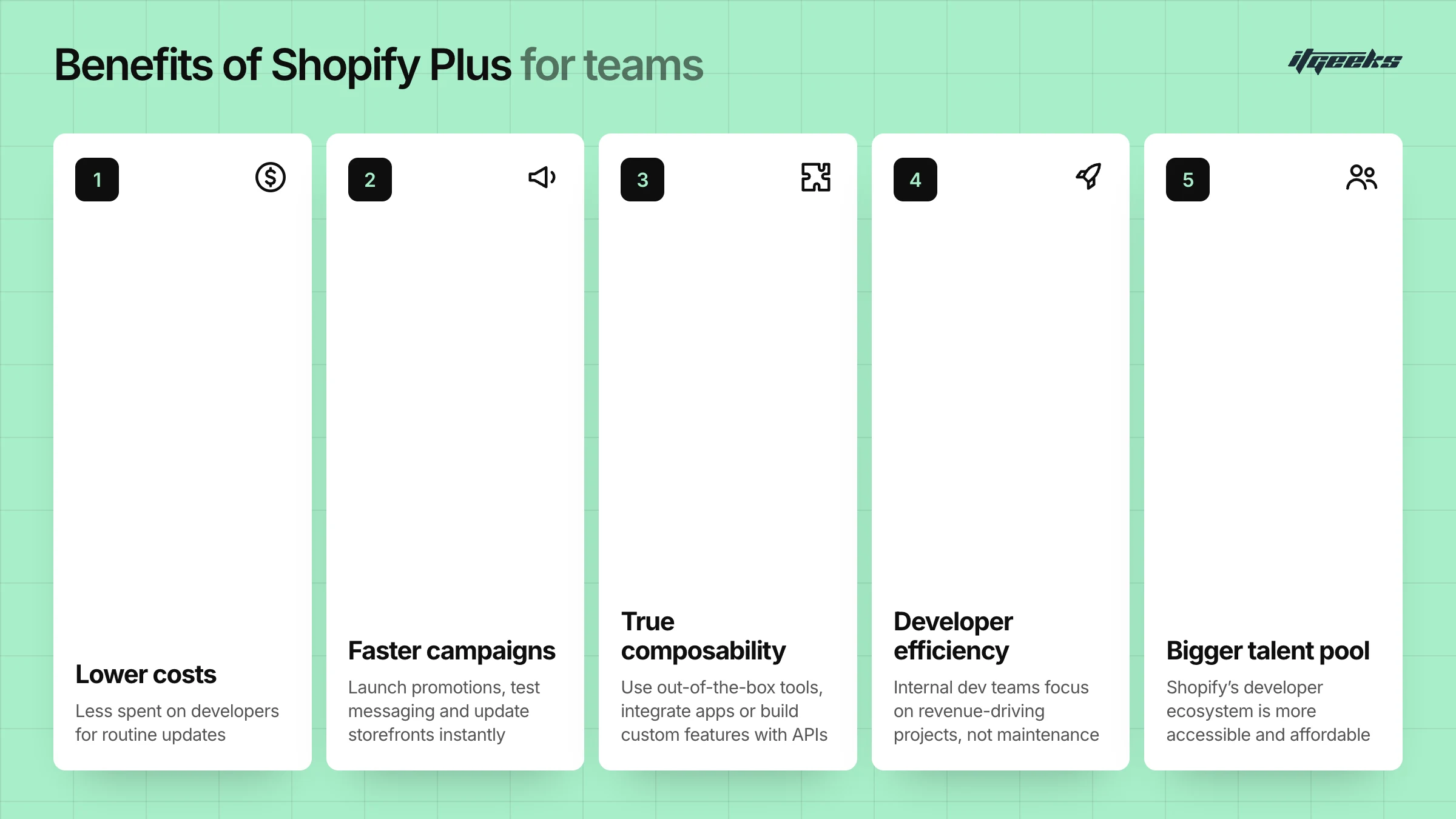
A chart explaining the benefits of Shopify Plus, such as lower cost, faster campaigns, composability, and more.
Analysts back this up: Shopify was named a Leader in the Gartner® Magic Quadrant™ for Digital Commerce (2023 & 2024), with 73% of the top 800 global DTC brands already on Shopify, according to Shopify’s own marketing. Shopify was also named a Leader in 2025, with the highest position for Ability to Execute. The Gartner details are on Shopify’s Gartner page; Gartner does not endorse any vendor in its research publications, and we could not find a published method for the 73% figure.
What Changes When You Migrate from Salesforce Commerce Cloud to Shopify Plus?
A migration from SFCC (Demandware) to Shopify Plus moves your catalog, customers, orders and content to a new platform, and rebuilds the integrations and custom code that Salesforce controlled. The work is mostly planning: mapping every URL, deciding what to rebuild or replace with apps, and testing before launch.
The points that matter most:
URLs and SEO: Map every old URL to its new equivalent and use permanent 301 redirects, sending each old URL straight to its final destination. Google recommends keeping redirects in place for at least a year (Google’s site move guidance). Shopify Plus stores can hold up to 20,000,000 redirects and can import them by CSV (Shopify Help Center). Read our guide to maintaining SEO rankings during a Shopify Plus migration.
Data and customer accounts: Products, customers and orders are migrated in a set order. Customer passwords usually cannot be carried across between platforms, so plan a re-activation email for account holders.
Integrations: Connections to your ERP, OMS, CRM and marketing tools that relied on SFCC custom code need to be rebuilt or replaced with apps and APIs. If you use Salesforce CRM or Marketing Cloud, these can usually stay in your stack and be connected to Shopify, which we scope during discovery.
Checkout logic: Discounts and checkout rules are rebuilt with Shopify Functions and Checkout Extensibility.
Timeline: We typically scope 6 to 12 weeks, depending on store complexity. Large catalogs, multiple regions and many integrations can take longer.
For a wider checklist, see our posts on Shopify Plus migration mistakes to avoid and how to migrate to Shopify without the hassle.
When Staying on Salesforce Commerce Cloud May Still Make Sense
Migration is not right for every business. If you are mid-contract with large switching costs, run deeply customized order management on Salesforce, or your team relies on a tightly integrated Salesforce CRM and clienteling setup, a full replatform may not pay back quickly. A short audit of costs, conversion and release speed will tell you whether the case is strong enough.
How Choosing Shopify Plus Means Future-Proofing Your Business
Migrating to Shopify Plus isn’t just about solving today’s challenges, it’s about setting your business up for tomorrow.
→ With enterprise-grade security and compliance (PCI DSS Level 1, SOC 2, GDPR-ready), you get peace of mind that your store is built on a platform trusted by the world’s fastest-growing brands. Shopify publishes its PCI, SOC 1, SOC 2 and SOC 3 reports in the Help Center.
→ Native B2B tools like custom catalogs and company accounts make wholesale as seamless as direct-to-consumer, while Shopify POS and Markets connect your brand globally.
→ And when it comes to scalability and performance, Shopify Plus is battle-tested, handling record Black Friday Cyber Monday volume: in 2025, Shopify merchants sold $14.6 billion globally, with peak sales of $5.1 million per minute on Black Friday (Shopify, unaudited data).
→ Add to this Shopify’s pace of constant innovation, from AI-driven personalization to agentic commerce, and you have a platform designed to evolve with the future of commerce.
In short: with Shopify Plus, you’re not just migrating, you’re investing in a foundation that keeps your business competitive no matter how fast the industry changes.
Our Two Cents
Now that we have discussed how Shopify can support your business grow and how it holds upper hand in terms of cost, agility, reliability and performance, you can analyse your current platform’s capabilities on these parameters - and if you feel your platform isn’t supporting your growth - it's high time to consider a shift.
If you need help understanding and analysing your businesses’ current performance and capabilities - we can help you. At ITGeeks, we hold the value of business supporting the businesses and hence, we stay true to our words - we provide you with honest analysis - not fluff to get you migrated.
With 250+ platform migrations under our belt and the honor of being a Shopify Platinum Partner, we don’t just talk about results, we’ve delivered them. You can explore our case studies to see how we’ve helped brands like yours scale smarter with Shopify Plus.
When you’re ready, we can join hands to map out your growth, together. Talk to our experts, and we’ll walk you through where you stand today, what’s holding you back, and how Shopify Plus can become the growth engine your business needs.
FAQ Section
Why do businesses migrate from Salesforce Commerce Cloud to Shopify Plus?
Many businesses switch to Shopify Plus for its faster innovation cycle, lower total cost of ownership, and a more user-friendly platform that enables quicker scaling and better conversion rates. Shopify’s own research reports up to 36% higher checkout conversion and up to 35% lower total cost of ownership versus Salesforce Commerce Cloud.
Is Shopify Plus more cost-effective than Salesforce Commerce Cloud?
Yes. Shopify Plus typically reduces licensing and development costs while providing enterprise-grade features out of the box, offering better value for growing brands. Your result depends on your GMV, integrations and team, so compare a Salesforce quote against Shopify Plus pricing for your own volumes; Shopify-commissioned research found up to 35% lower total cost of ownership.
How does Shopify Plus handle scalability for large businesses?
Shopify Plus supports unlimited bandwidth, high traffic volumes, multi-currency, and international storefronts, making it easy for large enterprises to scale globally with strong performance and reliability. In Black Friday Cyber Monday 2025, Shopify merchants sold $14.6 billion in total, with peak sales of $5.1 million per minute.
Does migrating from Salesforce to Shopify affect SEO?
If the migration is carefully planned with proper 301 redirects, structured data, and content preservation, SEO can be maintained or even improved, protecting search rankings through the transition. Map every old URL to a new one, avoid redirect chains, and monitor Google Search Console after launch.
What is the typical timeline for migrating from Salesforce to Shopify Plus?
Most migrations take between 6 to 12 weeks, depending on the complexity of the store, with proper planning enabling a smooth and efficient transition. Large catalogs, many integrations or multiple regions can extend this.
Who migrates legacy platforms to Shopify Plus?
Enterprise and high-growth brands that have outgrown a legacy or heavyweight platform migrate to Shopify Plus. They typically come from Salesforce Commerce Cloud (Demandware), Adobe Commerce (Magento), BigCommerce, WooCommerce or a homegrown system; Dollar Shave Club, for example, moved from a homegrown platform, according to Shopify’s case study. We cover the move from Magento in our post on why brands move from Adobe Commerce to Shopify Plus.
Can I keep Salesforce CRM or Marketing Cloud after moving to Shopify Plus?
Usually yes. Salesforce CRM and Marketing Cloud are separate from Commerce Cloud, so many brands keep them and connect them to Shopify through apps or APIs. Integrations that depended on SFCC custom code need to be rebuilt, and we scope this during discovery.
What is Demandware, and how does it relate to Salesforce Commerce Cloud?
Demandware is the former name of the platform that is now Salesforce B2C Commerce, part of Salesforce Commerce Cloud (SFCC). Many developers and merchants still say Demandware or SFCC, so a “Demandware to Shopify Plus” migration is the same move as Salesforce Commerce Cloud to Shopify Plus.
Why do businesses switch away from Shopify?
Businesses that switch away from Shopify usually do so because they want full control of their own infrastructure, are tied to another ecosystem such as Salesforce, or find platform fees and app dependence a poor fit as they grow. Shopify does not publish churn data, and we found no Plus-specific survey of why merchants leave, so treat these as common themes rather than statistics. If you are unsure whether to stay or move, our guide to whether Shopify Plus is the right fit can help.